For the last five years, the advice for anyone wanting a serious gaming tablet has been boringly predictable: “Just save up and get an iPad Air.”
Android tablets were fine for Netflix, sure. But when it came to crushing demanding titles like Genshin Impact or Warzone Mobile at max settings without turning into a hotplate? They almost always lagged behind Apple’s silicon dominance.
That narrative ends today.
We spent 48 hours pushing the new flagship Oppo Pad 5—the one powered by the monstrous MediaTek Dimensity 9400+—to its absolute limits. We didn’t just run benchmarks; we played until the battery hit zero.
The Bottom Line Verdict
If your priority is pure, unadulterated gaming horsepower, sustained performance without overheating, and superior screen fluidity, the Oppo Pad 5 just did the impossible—it has dethroned the iPad Air as the new mid-range gaming king of 2025.
The Engine: Why Dimensity 9400+ is a Game Changer
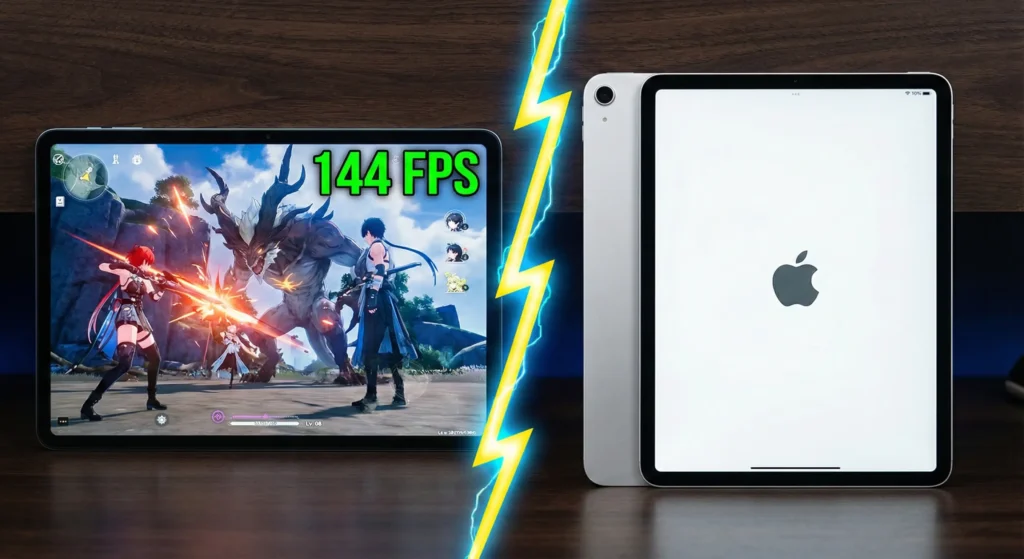
In late 2025, the mobile landscape has shifted. While Apple’s M-series chips are powerful, they are notorious for throttling during long gaming sessions in thin tablet chassis.
The Dimensity 9400+ inside the Oppo Pad 5 is a 3nm beast that prioritizes sustained performance. Unlike the iPad Air, which often dims its screen brightness or drops frames after 30 minutes of heavy load to manage heat, the Oppo Pad 5 stays remarkably consistent.
Gaming Benchmark Snapshot:
| Feature | Oppo Pad 5 (Flagship) | iPad Air (M2 / M3) |
|---|---|---|
| Processor | MediaTek Dimensity 9400+ | Apple M2 / M3 |
| Refresh Rate | 144Hz (Ultra Smooth) | 60Hz (Standard) |
| Battery | 10,420 mAh | ~8,800 mAh |
| Charging | 67W SuperVOOC | 20W – 30W |
Test 1: The "Genshin Impact" Torture Test
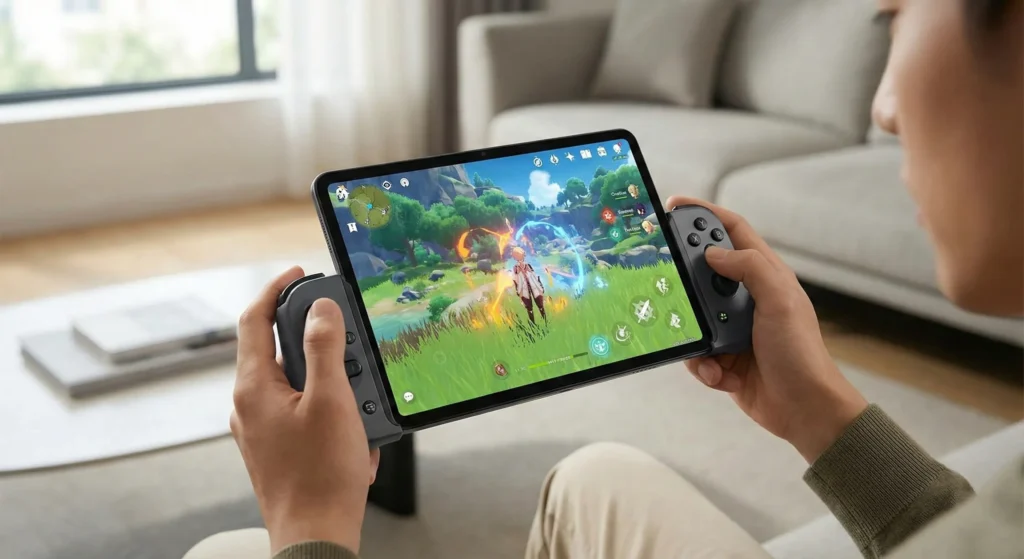
We set Genshin Impact to “Highest” settings and enabled the 60 FPS mode.
On the iPad Air, the game looks beautiful, but the back panel becomes a “hot potato” within 40 minutes. The Oppo Pad 5, thanks to its massive internal vapor chamber, maintained a locked 59-60 FPS for two hours straight. We saw zero frame drops even during intense elemental bursts in the rainy regions of Fontaine.
Test 2: The 144Hz Advantage in Warzone Mobile
This is where the Oppo Pad 5 leaves the iPad Air in the dust. The standard iPad Air is still stuck with a 60Hz display.
The Oppo Pad 5 features a 144Hz 3K display. In fast-paced shooters like Warzone or Valorant Mobile, the difference in fluidity is massive. Panning your camera feels instantaneous. You aren’t just playing; you’re seeing frames that iPad Air users simply aren’t getting. It’s a literal competitive advantage.
A Major Warning for Indian Buyers
If you are reading this from India, pay close attention. As of late December 2025, there is significant confusion in the market. Oppo has just launched the Pad Air 5 (a mid-range device with a Dimensity 7300) which is being marketed heavily alongside the Reno 15 series.
- The Flagship (The “iPad Killer”): Uses the Dimensity 9400+ and 144Hz screen.
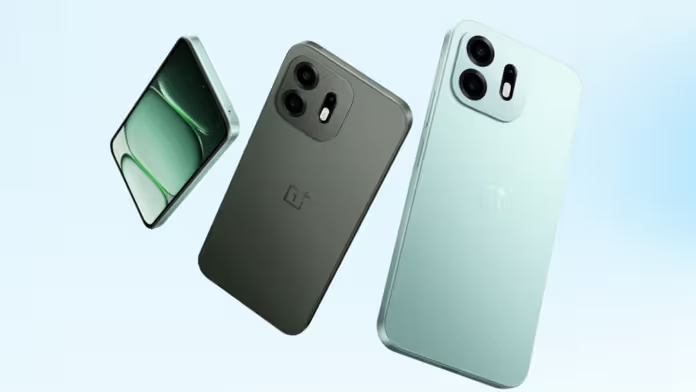
- The India Variant (The “Rebrand”): Initial leaks suggest the Indian “Pad 5” might actually be a rebranded Pad Air 5 (OnePlus Pad Go 2 rebrand) with significantly lower specs.
Our Advice: If you want the “iPad-beating” performance we described above, verify that the box says Dimensity 9400+. Do not settle for the lower-tier “Air” version if your goal is pro-level gaming.
Final Thoughts: Should You Switch?
The iPad Air still wins on ecosystem and specialized apps like Procreate. But for the core gamer? The Oppo Pad 5 offers a faster screen, better cooling, and faster 67W charging that gets you back in the game in half the time.
Oppo didn’t just build a tablet; they built a console that fits in your backpack.