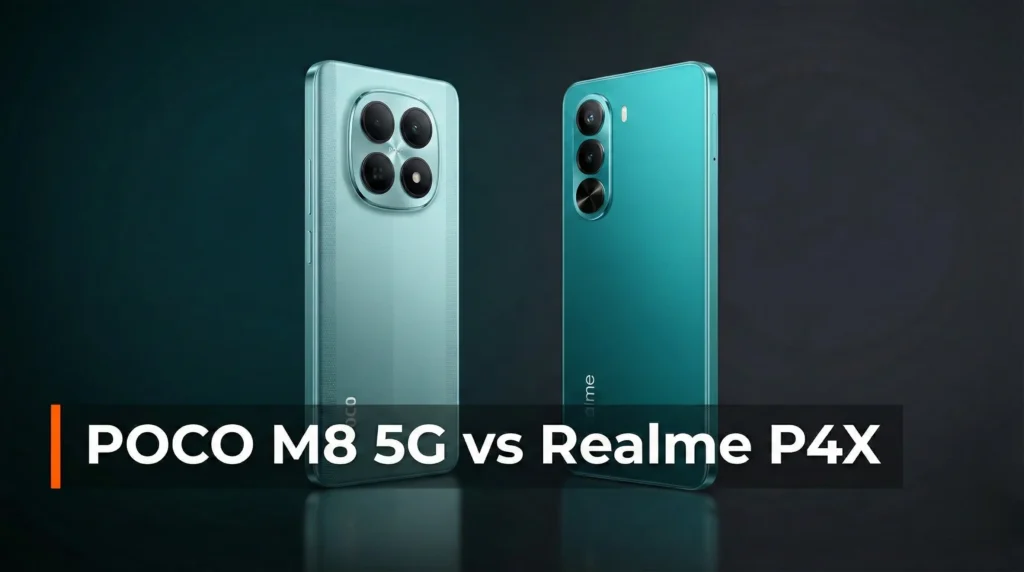
The POCO M8 5G and Realme P4X target the same mid-range price bracket, but they take radically different approaches. One focuses on long-term software support and a premium display experience, while the other prioritizes raw battery capacity and sustained gaming performance.
As the mid-range segment matures in 2026, choosing the right phone is less about headline specs and more about how well it fits your daily usage — and how long it remains relevant.
Display and Design: Why Panel Technology Matters
The first and most immediately noticeable difference between these two phones is the display technology. The POCO M8 5G uses a 6.77-inch 3D Curved AMOLED panel, while the Realme P4x uses a 6.72-inch LCD screen.
To understand why this matters, it helps to know how the two technologies differ. An AMOLED (Active Matrix Organic Light-Emitting Diode) display lights each pixel individually, which means pure blacks are truly black (the pixel simply turns off) and colors appear far more vibrant and saturated. An LCD panel, by contrast, uses a backlight behind the entire screen, which can cause blacks to look grayish and colors to appear flatter, particularly in dark environments.
In practical terms, the POCO’s AMOLED display — with a peak brightness of 3,200 nits — will look significantly more vivid indoors and remain clearly readable even under direct sunlight, which is a meaningful advantage in India’s climate.
AMOLED (POCO M8 5G)
- Each pixel lights independently
- True blacks (pixels switch off completely)
- Higher contrast and richer color output
- 3,200 nits peak brightness
- Superior outdoor visibility in bright sunlight
LCD (Realme P4X)
- Single backlight behind entire panel
- Blacks may appear gray in dark scenes
- Lower contrast compared to AMOLED
- Brightness and color depth less dynamic
The Realme P4x counters with a 144Hz refresh rate versus the POCO’s 120Hz, meaning its screen refreshes slightly more times per second, which can make scrolling and animations appear marginally smoother.
However, for most users, this difference is difficult to perceive in everyday use, whereas the AMOLED vs. LCD gap is immediately visible. The POCO also wins significantly on build: at 7.35mm and 178g, it is noticeably thinner and lighter than the P4x, which measures 8.39mm and 208g.
Performance: The Processor Debate
The Realme P4x is powered by the MediaTek Dimensity 7400 Ultra, which achieves approximately 1,000,000 points on the AnTuTu benchmark — a widely used tool for measuring overall processing speed. The POCO M8 5G uses the Qualcomm Snapdragon 6 Gen 3, which scores around 860,000 on the same benchmark. On paper, the P4x is the faster phone.
Realme P4X — Raw Power Advantage
- Higher AnTuTu score (~1M)
- Better sustained gaming performance
- Stronger handling of AI-heavy tasks
- UFS 3.1 storage for faster read/write speeds
POCO M8 5G — Balanced Daily Performance
- Efficient 4nm Snapdragon 6 Gen 3
- Smooth for social media, browsing, streaming
- Stable thermal performance in daily use
- Real-world performance feels equally responsive
However, raw benchmark numbers require some context. In day-to-day use — browsing, social media, video streaming, productivity apps — both chips are more than capable, and the difference is imperceptible. The gap becomes relevant primarily in sustained, high-intensity tasks like running graphically demanding games at high settings for extended periods, or handling the more demanding on-device AI features that are becoming common in 2026 apps.
The P4x also benefits from UFS 3.1 storage, which is faster at reading and writing data than what the POCO offers. For competitive mobile gamers or power users, the P4x’s performance edge is real. For everyone else, both phones feel equally snappy in practice.
Software Longevity
This is arguably the most important consideration when evaluating a phone as a long-term investment, and it is where the two devices diverge most sharply.
POCO has committed to providing the M8 5G with four years of Android OS updates and six years of security patches. This means a phone purchased today will continue receiving new Android versions until 2030, and security fixes until 2032. Security patches matter because they protect your device from newly discovered vulnerabilities — a phone that stops receiving them becomes progressively more exposed to threats over time.
Realme, by contrast, offers only two years of OS updates and three years of security patches for the P4x. In practical terms, this means the P4x will likely be stuck on its current Android version by early 2028, while the POCO continues to evolve.
If you intend to use your phone for three to five years — which is increasingly common as phones become more expensive and users become more environmentally conscious — this is a critical difference.
Battery and Charging
The Realme P4x carries a massive 7,000mAh battery, which is designed specifically for users who need two full days of usage between charges. For heavy travelers, students, or field professionals who spend long hours away from a power outlet, this is a compelling advantage that is difficult to overstate.
Realme P4X — 7,000mAh Titan Battery
- Designed for 2 full days of usage
- Ideal for travelers & field professionals
- Reduced charging frequency
- 45W fast charging support
POCO M8 5G — Versatile Charging Features
- Comfortable full-day endurance
- 18W reverse wired charging
- Can function as a power bank
- 45W fast charging support
The POCO M8 5G houses a 5,520mAh battery, which under normal usage should still comfortably last a full day. What it offers uniquely is 18W reverse wired charging, which allows the phone itself to act as a power bank — a useful feature if you frequently need to top up wireless earbuds, a smartwatch, or a friend’s phone on the go. The POCO also supports 45W fast charging.
IP Rating and Camera
One detail worth noting is the IP rating. The POCO M8 5G carries an IP66 certification, meaning it is protected against powerful water jets and dust ingress — a meaningful real-world assurance.
The Realme P4x has an IP64 rating, which protects against splash and light dust but is less robust. On the selfie camera front, the POCO offers a 20MP front camera versus Realme’s 8MP, which is a significant gap for users who prioritize video calls or self-portraits.
The Bottom Line
| Feature | POCO M8 5G | Realme P4x |
|---|---|---|
| Display | 6.77″ Curved AMOLED (120Hz) | 6.72″ LCD (144Hz) |
| Processor | Snapdragon 6 Gen 3 | Dimensity 7400 Ultra |
| OS / Security Updates | 4 years / 6 years | 2 years / 3 years |
| Battery | 5,520 mAh | 7,000 mAh |
| Selfie Camera | 20 MP | 8 MP |
| IP Rating | IP66 | IP64 |
| Approx. Price | ₹17,999 | ₹15,999 |
The POCO M8 5G makes the most sense if you plan to keep your phone for three years or more. Its AMOLED display, lighter form factor, superior software support lifecycle, better IP rating, and stronger selfie camera make it the more well-rounded device — and one that will genuinely age better over time. The ₹2,000 premium over the P4x is money well spent when you consider that the phone will remain secure and updated until 2030.
The Realme P4x, on the other hand, is the right choice for users with a specific and clear priority: maximum battery life and raw processing power at the lowest possible price. If you are a mobile gamer, a heavy outdoor user, or someone who simply cannot afford to run out of battery during the day, the P4x delivers exceptional value at ₹15,999. Just go in with the understanding that you are optimizing for performance today, not necessarily for longevity.