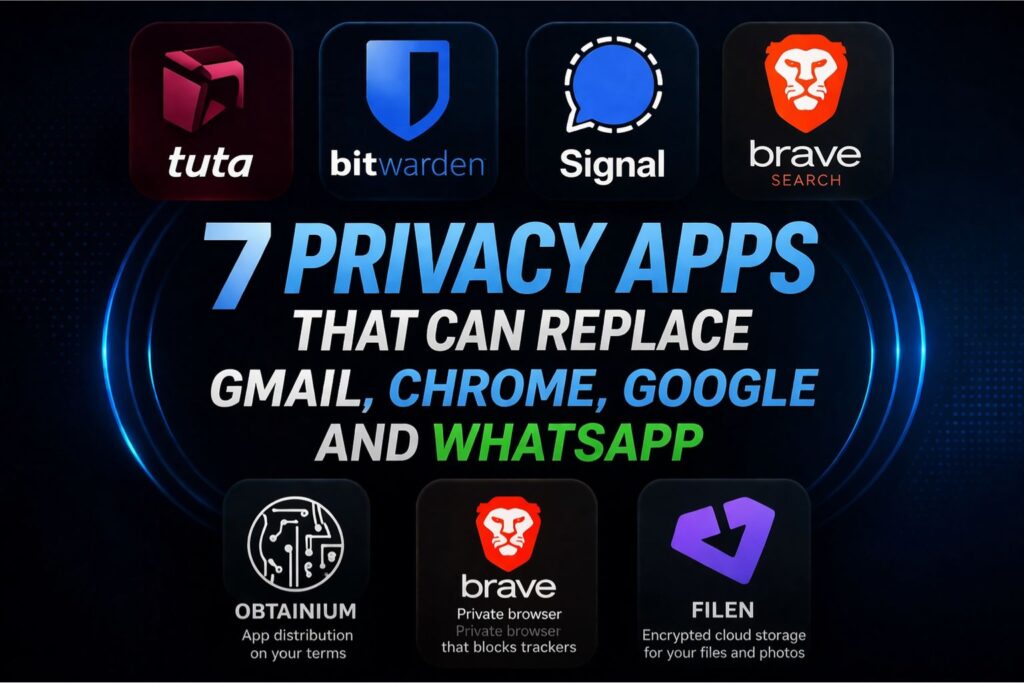
Many popular apps are free to use, but they often rely on data collection for ads, analytics, and personalization. As privacy concerns grow, several alternatives now offer similar core features while limiting tracking. These privacy-focused apps aim to deliver familiar experiences for email, browsing, cloud storage, messaging, and security without heavy data collection.
Here are seven privacy apps that can replace commonly used services like Gmail, Chrome, Google, and WhatsApp.
1. Tuta as a Gmail Alternative

Tuta is an end-to-end encrypted email service designed with privacy as the default. It encrypts mailbox content and minimizes metadata collection. The interface is clean and works across mobile and web, making the transition from Gmail relatively simple.
Users moving from Gmail may notice fewer AI-powered features and limited ecosystem integrations. However, core functionality such as folders, search, attachments, and notifications remains similar for everyday use.
2. Brave as a Chrome Alternative
Brave is a Chromium-based browser that blocks ads and trackers by default. It also includes built-in protections against fingerprinting and automatic HTTPS upgrades. Because it is based on Chromium, the layout feels familiar and supports most Chrome extensions.
The main difference is that privacy protections are enabled out of the box. This reduces the need for additional extensions and can improve loading speeds, especially on mobile connections.
3. Brave Search as a Google Alternative
Brave Search provides web results without heavy personalization. It is designed to reduce profiling and tracking while still offering images, news, and general search features. The interface remains simple and similar to traditional search engines.
Switching from Google may slightly change ranking behavior. Results are less influenced by user history, which improves privacy but may reduce personalized suggestions.
4. Filen as Google Drive and Photos Alternative
Filen offers encrypted cloud storage with zero-knowledge architecture. Files are encrypted before being uploaded, meaning the service cannot access user content. It supports file storage, photo backups, and cross-device syncing.
Compared to Google Drive and Photos, Filen focuses more on secure storage rather than AI organization or automatic categorization. For users prioritizing private backups, the experience remains straightforward.
5. Signal as a WhatsApp Alternative

Signal provides end-to-end encrypted messaging with minimal data collection. It supports chats, voice calls, video calls, and group conversations. The layout is similar to WhatsApp, which helps reduce switching friction.
The main difference is ecosystem size. Signal avoids deep platform integrations and collects less metadata, but most core messaging features remain intact.
6. Bitwarden for Passwords and Authentication
Bitwarden is an open-source password manager that stores credentials in encrypted vaults. It supports autofill, password generation, and multi-device sync. The experience is similar to browser-based password managers but with more transparency.
Because encryption happens before syncing, passwords remain protected even when accessed across devices.
7. Obtainium as a Play Store Alternative
Obtainium allows users to install apps directly from developer sources instead of centralized app stores. This reduces dependency on large marketplaces and gives users more control over updates.
The setup process is slightly different from the Play Store, as sources are added manually. Once configured, app updates and management remain simple.
Same Experience With Different Defaults
Switching to privacy-focused apps does not require changing how you use your phone. Email, browsing, messaging, storage, and passwords all work in familiar ways. The biggest difference is that tracking and data collection are limited by default.
For many users, replacing a few core apps is enough to reduce data sharing while keeping the overall experience unchanged. These privacy apps offer similar functionality while prioritizing user control and minimal data collection.