Forget step counting. Wearable tech just got serious about your health.
At the World Health Expo Dubai 2026, Huawei dropped a game-changer: a smartwatch that can detect early signs of diabetes risk. No needles, no blood, no lab visits required. It’s already rolling out on the HUAWEI WATCH GT 6 Pro, and it could change how millions of people catch this silent disease before it’s too late.
The Problem: Diabetes Hides Until It's Too Late
Here’s the scary part: nearly half of people with diabetes don’t even know they have it. Type 2 diabetes can develop quietly for years, silently damaging your heart, kidneys, and nerves while you go about your day. By the time symptoms show up, serious harm may already be done.
Traditional screening requires doctor visits, fasting, and finger-prick blood tests. Most people don’t bother until something feels wrong. That’s the gap Huawei is trying to close.
How a Watch Detects Diabetes Risk
Huawei isn’t measuring your blood sugar directly. That would require breaking skin. Instead, it’s looking for the fingerprints diabetes leaves behind in your body.
The tech is called Photoplethysmography (PPG). It’s the same optical sensor tech that tracks your heart rate, but Huawei’s taking it further. Advanced sensors shine light into your wrist and measure how it bounces back from blood vessels beneath your skin.
Here’s what matters: diabetes doesn’t just mess with blood sugar. Over time, it changes your blood vessels and nerves. Research from the Shanghai Institute of Hypertension found that these tiny vascular changes, like hardening of small arteries, alter the light patterns PPG sensors pick up.
Huawei’s algorithm analyzes these subtle shifts over time. Wear the watch consistently for 3 to 14 days, and it builds a baseline. Then it categorizes your risk: Low, Medium, or High.
If you land in Medium or High? The app nudges you to see a doctor for real testing, like an HbA1c blood test.
Why This Isn't a Medical Device (And Why That's Smart)
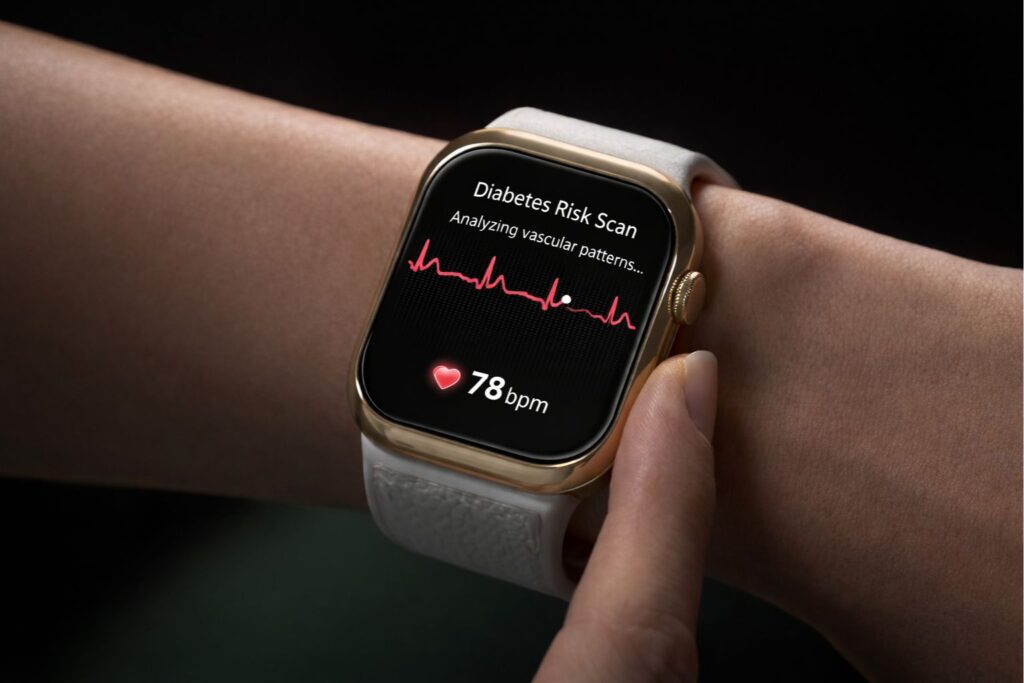
Huawei is careful not to call this a diagnostic tool. It’s a wellness feature, not a medical device. That’s a strategic move.
Getting FDA or medical regulatory approval takes years and requires clinical-grade accuracy. By positioning this as a risk awareness tool, not a diabetes detector, Huawei sidesteps those hurdles and gets the tech into people’s hands now.
It’s not replacing your doctor. It’s tapping you on the shoulder and saying, “Hey, maybe get this checked out.”
Which Watches Have It?
Right now, the diabetes risk feature is exclusive to the HUAWEI WATCH GT 6 Pro. It’s available via a free software update. No subscription, no extra hardware.
Huawei says broader compatibility across its smartwatch lineup is coming in late 2026.
The Competition: Apple and Garmin Are Also Racing
Huawei isn’t alone in chasing non-invasive glucose monitoring, but they took a different route and got there first.
Apple: Rumored to be developing direct blood sugar measurement using advanced photonics. Sounds impressive, but it’s still in the lab.
Garmin: Testing HbA1c estimation with multi-wavelength sensors. Also not public yet.
Huawei: Skipped the “perfect accuracy” race and focused on risk trends. Result? A working feature consumers can use today.
Why This Matters
According to the International Diabetes Federation, hundreds of millions of adults worldwide have diabetes. Nearly 43% are undiagnosed.
That’s not just a statistic. It’s a ticking time bomb of heart attacks, kidney failure, and nerve damage waiting to happen.
Huawei’s smartwatch turns passive wrist-wearing into active health surveillance. You’re not thinking about diabetes. Your watch is.
This is preventative care at scale. No appointments. No reminders. Just continuous, silent monitoring that alerts you when something might be off.
The Bigger Picture
Wearables have spent the last decade quantifying fitness. Now they’re moving into medical territory, quietly, cleverly, and effectively.
Huawei’s diabetes feature won’t diagnose you. But it might save your life by getting you to a doctor years earlier than you would’ve gone on your own.
And that’s the point. The best medical intervention is the one that happens before you need it.
Bottom line? Your smartwatch just became your metabolic watchdog. And that future is already here.