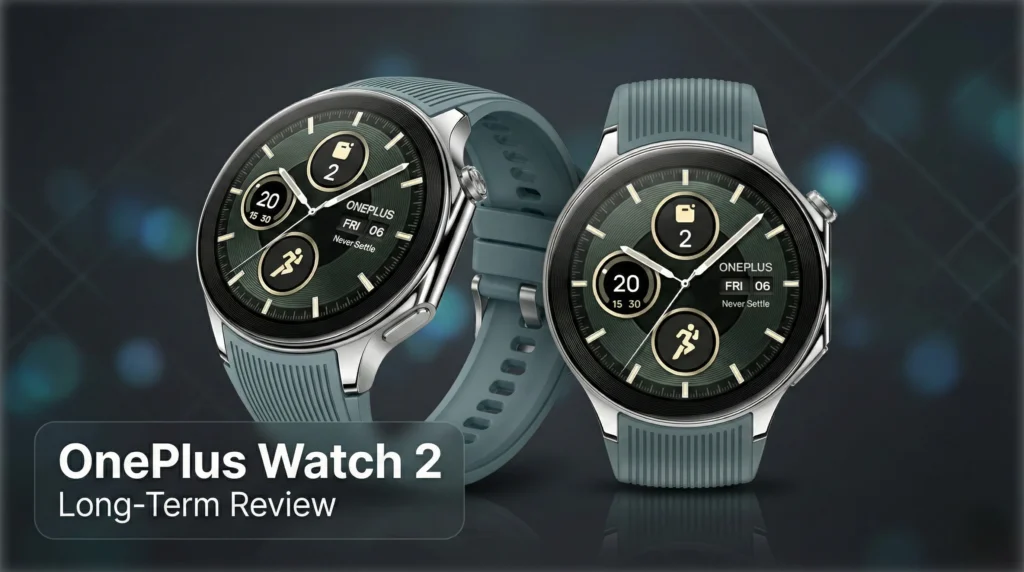
The OnePlus Watch 2 still leads Wear OS in battery endurance, but software uncertainty and stronger competition make it a smart buy only at a discounted price.
Key Specifications
Display: 1.43-inch AMOLED, 466 × 466 resolution (326 ppi)
Processor: Snapdragon W5 Gen 1 + BES2700 co-processor
RAM: 2GB
Storage: 32GB
Battery: 500mAh
Charging: 7.5W AIRVOOC wireless charging
Operating System: Wear OS 4
Sensors: Heart rate (HR), SpO2, dual-band GPS, accelerometer, gyroscope, altimeter, ECG (region-specific)
Connectivity: Bluetooth 5.3, Wi-Fi (2.4GHz / 5GHz), NFC
Weight: Approximately 49g on the wrist
Quick Verdict
Its strengths are real: 3–4 days of battery life, a sharp sunlight-readable AMOLED display, smooth Wear OS performance, and a durable IP68 + 5ATM build.
Its weaknesses are equally real: a bulky 47mm case, no ECG in many regions, health sensors that trail Garmin and Apple, and no confirmed long-term software update commitment.
It’s best suited to Android users who want Google ecosystem features and long battery life without paying Samsung or Google prices. It’s not the right pick for serious athletes, smaller-wristed users, or anyone who needs guaranteed multi-year OS support.
Design & Durability
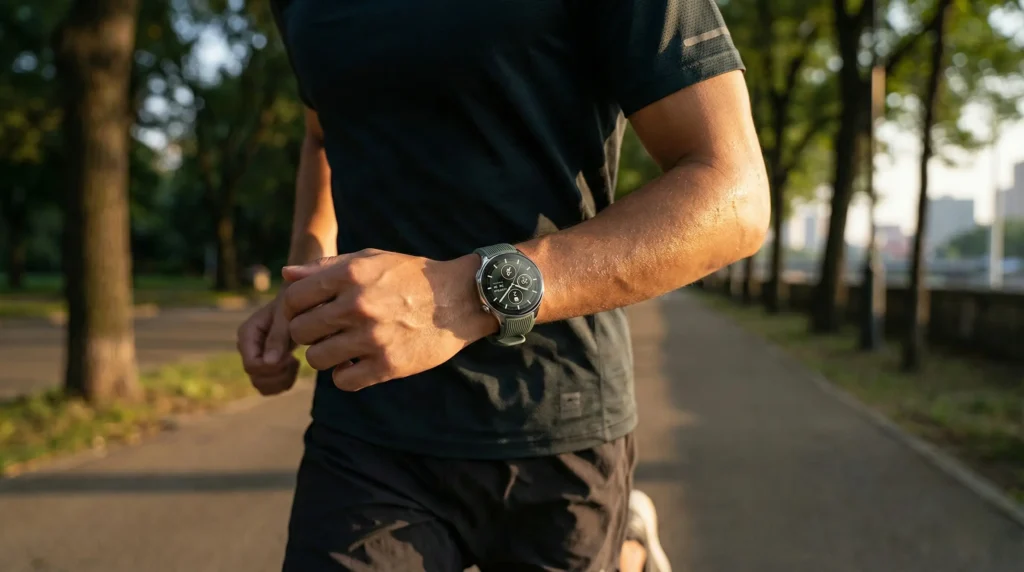
The aluminum case with sapphire crystal glass holds up well after prolonged daily use — surface scratches are minimal and the glass resists minor impacts better than standard mineral crystal.
The fluoroelastomer strap begins showing wear at connector points around the 12–18 month mark, but standard 22mm replacements are cheap and widely available. The IP68 + 5ATM rating remains intact with normal use. The 47mm size is comfortable for medium-to-large wrists but genuinely unwieldy for smaller ones, particularly during sleep.
Display
The AMOLED panel is a consistent highlight. It’s sharp, color-accurate, and readable in direct sunlight at peak brightness — something cheaper panels still struggle with. Always-on display reduces battery endurance by roughly 20–30%, so most users tracking runtime carefully will leave it off.
Performance & Wear OS in 2026
The dual-chip design — W5 Gen 1 for active tasks, BES2700 for background monitoring — is the reason battery life is this good without sacrificing responsiveness.
App navigation and notification handling feel smooth. Wear OS 4 covers the practical daily bases: Google Maps, Google Wallet, Assistant, Play Store.
The app catalog is still thinner than watchOS, and some fitness platforms offer more complete experiences on competing platforms, but for notifications, payments, and navigation it does the job reliably.
Battery Life After 1+ Year
This remains the watch’s defining advantage. Real-world usage with AOD off and moderate notifications lands at 3 to 4 days per charge. Heavy GPS use – daily outdoor runs or rides – brings that down to roughly 1 to 2 days.
After 12 to 18 months of regular charging, expect 10 to 20% capacity degradation, meaning a watch that ran 4 days at launch may now average 3 to 3.5. That’s still ahead of the Galaxy Watch 7 or Pixel Watch 3, which both need nightly charging. The 7.5W wireless charger gets from 0 to 100% in under 75 minutes, softening the impact when you do need to charge.
Health Tracking
Resting heart rate readings are reasonably accurate for general awareness. During high-intensity exercise, optical wrist-based HR loses precision — not a surprise, but worth stating clearly if you’re training by zone. SpO2 gives a rough overnight reference but isn’t medically actionable. ECG (where available) can flag potential atrial fibrillation, which is genuinely useful, but many markets including India don’t have it enabled.
Sleep tracking works functionally, though the watch’s size makes consistent overnight wear uncomfortable for some users, which undermines the data.
Smart Features & Usability
Notifications, Google Wallet, Maps navigation with haptic turn prompts, voice assistant, and media controls all work reliably day-to-day. Hands-free calling through the speaker is intelligible indoors but degrades in noisy environments — most users will grab their phone. Watch face customization through Wear OS has improved meaningfully since launch.
Software Support
This is the biggest open question in 2026. The watch launched on Wear OS 4 and has received patches, but OnePlus has not committed to a multi-year update schedule the way Google does for Pixel Watch or Samsung does for Galaxy Watch. Verify current update status directly with OnePlus before purchasing. If software longevity matters to you, this is a real risk factor.
Connectivity & Compatibility
Bluetooth 5.3 is stable at normal indoor ranges. Wi-Fi lets the watch sync independently from the phone. NFC payments work reliably. It’s Android-only — no iOS support, and none is coming. It pairs with any Android 8.0+ phone, which is a genuine advantage over Samsung’s Watch lineup that works best within Samsung’s own ecosystem.
How It Compares in 2026
The Samsung Galaxy Watch 7 offers better health accuracy and clearer software support commitments – but it charges nightly and costs more. The Pixel Watch 3 has the tightest Google integration and first-in-line Wear OS updates, but its battery life is the shortest of the three. Garmin’s Forerunner 265 dominates on training accuracy and battery longevity (13+ days), but runs Garmin’s own OS with no NFC payments. The OnePlus Watch 2 sits between these as the endurance-first, value-oriented option. Confirm current pricing with official sources – market prices shift.
Should You Buy It?
Buy it if you’re an Android user who wants 3 to 4 day battery life, Google ecosystem features, and NFC payments, and you find it discounted to around $200 or below — in India, it currently retails around Rs. 13,495, making it a strong value pick at that price. Skip it if you need guaranteed software longevity, clinical health tracking accuracy, a smaller form factor, or ECG in an unsupported region. Look elsewhere if software support is the priority (Pixel Watch 3 or Galaxy Watch 7), training accuracy matters (Garmin), or you’re a Samsung phone owner who’d benefit from Galaxy ecosystem integration.
At the right price, it’s a strong value buy. At its original Indian launch price of Rs. 24,999, the competition has caught up enough that it’s harder to recommend without hesitation — but at its current street price, the calculus shifts considerably in its favour.