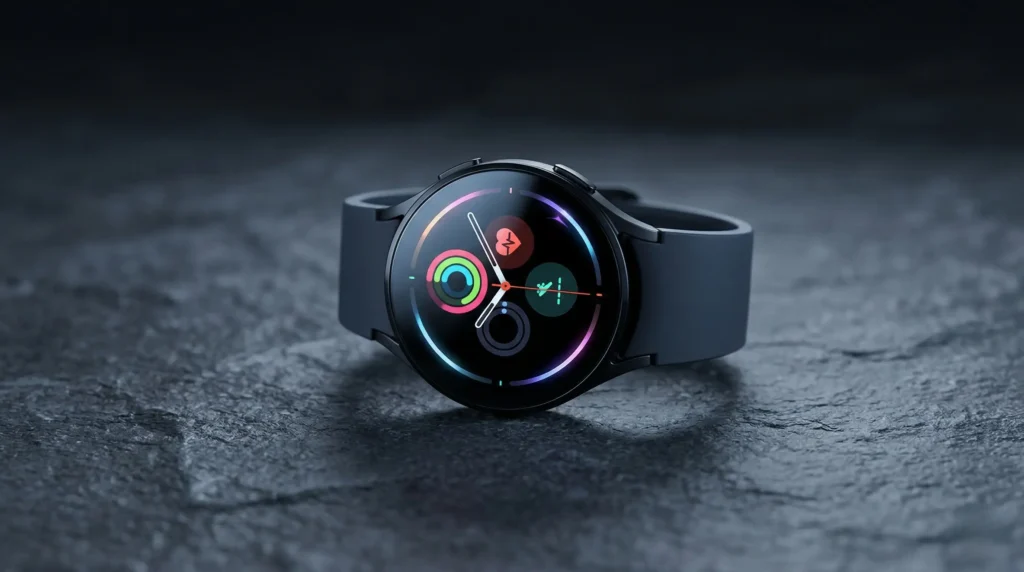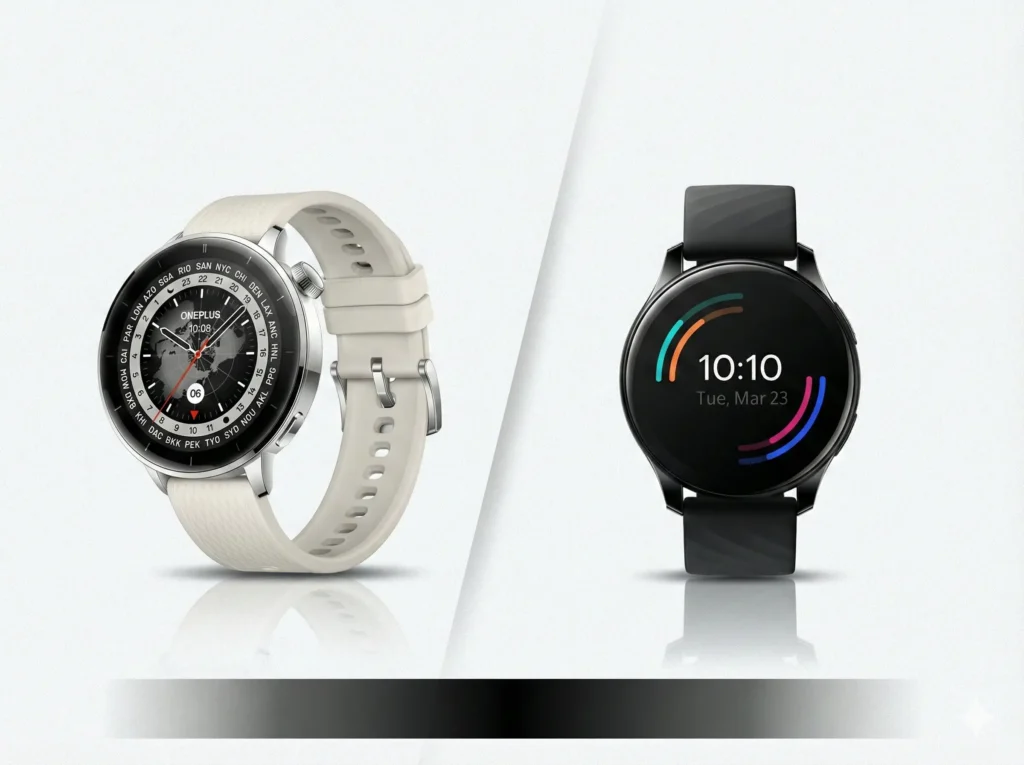
The OnePlus Watch 3 launched in February 2025 with an ambitious promise — flagship Wear OS features paired with multi-day battery life. A year on, here is an objective assessment of how it performs in real-world, sustained use.
Battery Life: How the Dual-Chip Architecture Works in Practice
The Watch 3’s standout specification is its 631mAh battery, supported by a dual-chip system. The Snapdragon W5 processor handles active Wear OS functions, while the BES2800 co-processor manages background tasks such as heart rate monitoring and step counting. This division of labor reduces power draw significantly.
In practice, this translates to:
- Always-On Display enabled (with continuous heart rate tracking, sleep monitoring, and 45 minutes of daily GPS use): 3–4 days per charge
- Always-On Display disabled: 5–6 days per charge
One underappreciated long-term benefit: because the watch charges only once or twice per week, the battery accumulates far fewer charge cycles than a watch requiring nightly charging. After a year of use, battery degradation remains minimal for most users.
Build Quality and Display
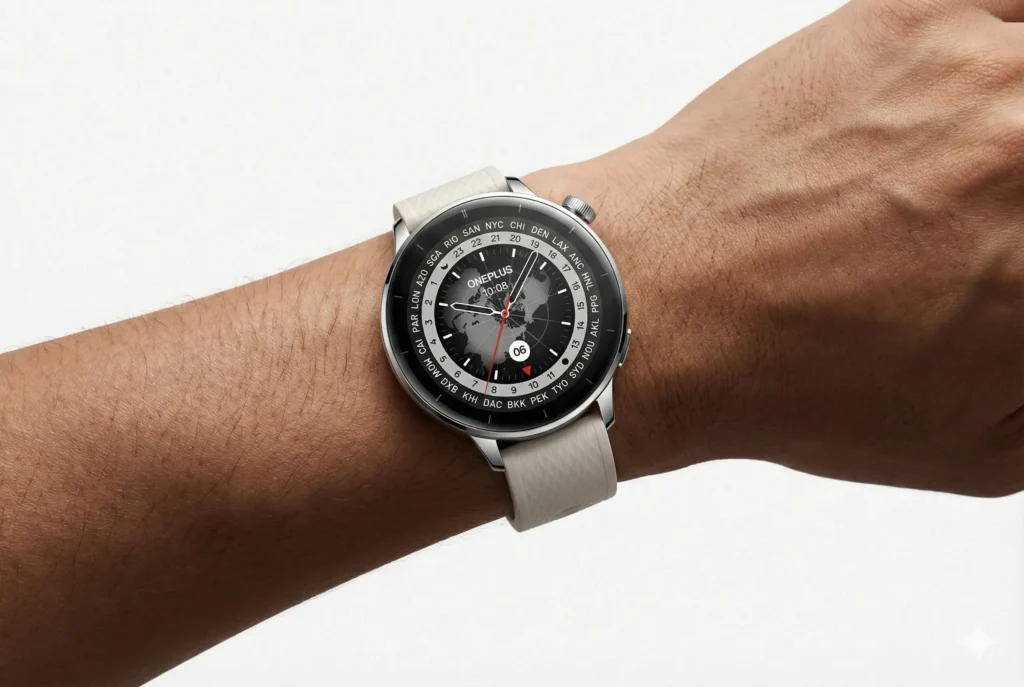
The Watch 3 uses a titanium bezel and sapphire crystal glass — materials associated with tool watches rather than consumer electronics. It carries MIL-STD-810H certification, 5ATM water resistance, and an IP68 dust-and-water rating, meaning it is rated for swimming, hiking, and incidental impacts.
The 1.5-inch LTPO AMOLED display peaks at 2,200 nits, which is sufficient for outdoor readability in direct sunlight. The rotating digital crown — absent on earlier OnePlus watches — provides physical scroll control with haptic feedback, a meaningful usability improvement.
One important consideration: The standard model is 47mm and weighs 81g with the strap, which is large by smartwatch standards. OnePlus addressed this in late 2025 with a 43mm variant better suited to smaller or average-sized wrists.
Health and Fitness Features
60-Second Health Scan: The watch consolidates heart rate, blood oxygen (SpO2), stress level, and arterial stiffness readings into a single one-minute session using the OHealth app. This is useful for quick daily check-ins without navigating multiple menus.
GPS Accuracy: The dual-frequency GPS (L1+L5) locks quickly and tracks routes with high precision — particularly relevant for runners and cyclists who want accurate distance and pace data rather than smoothed approximations.
Heart Rate Tracking: Reliable during steady-state cardio. During high-intensity interval training or heavy lifting, there can be a lag of a few seconds during sudden exertion spikes — a limitation common across optical heart rate monitors at this price point.
Sleep Tracking: Provides breakdowns of deep, REM, and light sleep stages, plus a snoring risk assessment. Longitudinal data from the OHealth app becomes more useful over weeks as it identifies patterns in sleep quality and recovery.
Software: One Year of Updates
The OHealth companion app has received sustained updates since launch, improving the interface and adding functionality.
Wear OS itself continues to receive Google’s periodic updates. The dual-chip architecture means software stability is largely unaffected by background sensor activity — a common source of lag on single-chip Wear OS devices.
Who Should Consider Buying It in 2026
The Watch 3 is now likely available at a discount from its original retail price, which improves its value proposition considerably.
It is well-suited for:
- Android users who find daily charging impractical
- Outdoor athletes who rely on accurate GPS tracking
- Users who want a durable, water-resistant watch for mixed environments
It is not the right choice for:
- iPhone users — the watch requires Android
- Users with smaller wrists who find the 47mm form factor uncomfortable (though the 43mm model resolves this)
- Those who prioritize a lightweight, minimal wearable over comprehensive features
Summary
The OnePlus Watch 3 remains one of the most practical Wear OS smartwatches available, primarily because it solves a problem most competitors have not: battery life that matches how people actually use their time. Its hardware has held up well over a year of daily use, and the software has improved rather than stagnated. For Android users, it warrants serious consideration in 2026 — particularly at a reduced price.