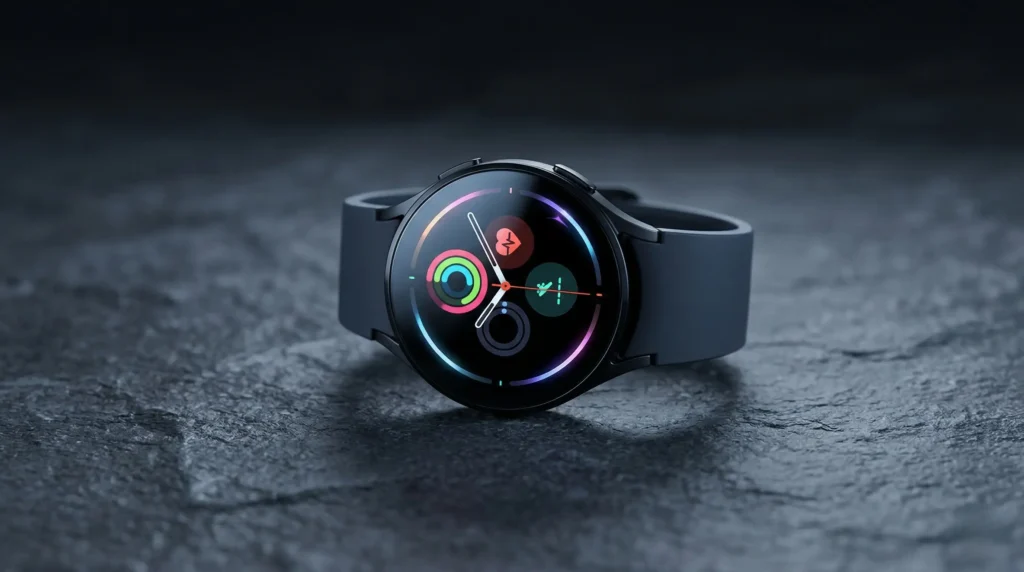
Battery life remains one of the most significant pain points for flagship smartwatch users. While many high-end devices require daily charging, leaks surrounding the upcoming OnePlus Watch 4 suggest a different approach. The industry is currently focused on reports that the new device might offer a baseline battery life of up to 100 hours.
Here is a look at the technology expected to power the watch, what supply chain leaks indicate about its specifications, and what consumers can expect when the device officially launches.
The Technology Behind the Battery Life

To achieve multiple days of battery life without significantly increasing the device’s physical footprint, OnePlus is reportedly continuing its use of a “Dual-Engine Architecture.”
According to recent certification leaks, the Watch 4 will utilize two distinct processors. The primary chip is expected to be Qualcomm’s Snapdragon W5 Gen 2, which will be paired with a high-efficiency co-processor, likely an upgraded BES chip.
For basic tasks—such as checking the time, receiving simple text notifications, or background step tracking—the watch operates on a Real-Time Operating System (RTOS) powered by the efficiency chip.
When more demanding applications are launched, such as GPS navigation or complex Wear OS apps, the Snapdragon processor activates, providing a full Android 16-based Wear OS 6 experience.
By dynamically switching between processors and shutting down the primary chip during idle periods, the watch is designed to conserve battery. This mechanism allows the device to reportedly reach over 100 hours in “Smart Mode” and potentially up to two weeks in a dedicated Power Saver Mode.
Hardware Specifications and Features
Despite the focus on battery efficiency, leaked specifications indicate that the Watch 4 will retain flagship-level hardware.
The device, currently appearing in regulatory databases under the model number OPWWE261, is expected to feature a 1.5-inch LTPO AMOLED display.
The LTPO technology allows the screen’s refresh rate to adjust dynamically, which is particularly useful for minimizing power consumption when the Always-On Display is active while maintaining a 466 x 466 resolution.
Externally, rumors suggest a premium build utilizing either a stainless steel or titanium alloy chassis, potentially protected by a sapphire crystal face.
In terms of health tracking, OnePlus is expected to include its “60-second Health Check-In” feature, which quickly monitors heart rate, blood oxygen (SpO2), and skin temperature. Industry reports also suggest the introduction of new health metrics this year, such as sleep breathing risk detection and arterial stiffness monitoring.
Shared Architecture with Oppo
Regulatory filings, including those from Malaysia’s SIRIM, indicate that the OnePlus Watch 4 will share significant manufacturing similarities with the upcoming Oppo Watch X3.
For consumers, this shared architecture often translates to inherited premium features. Notably, rumors suggest the watch will support 10W fast charging. If accurate, this could potentially provide a full 24 hours of battery life from a brief 10-minute charge.
Expected Launch and Pricing
While OnePlus has not officially announced a release date, the appearance of the device on international certification boards suggests a launch is imminent. Analysts expect the watch to debut in the late first quarter or early second quarter of 2026.
Official pricing remains unconfirmed, but OnePlus traditionally positions its wearables competitively against major smartwatch brands. Current market estimates suggest it will be priced around ₹28,999 in India.
If the OnePlus Watch 4 can successfully deliver a complete Wear OS experience alongside a reliable multi-day battery life, it has the potential to set a new benchmark for endurance in the mainstream smartwatch market.