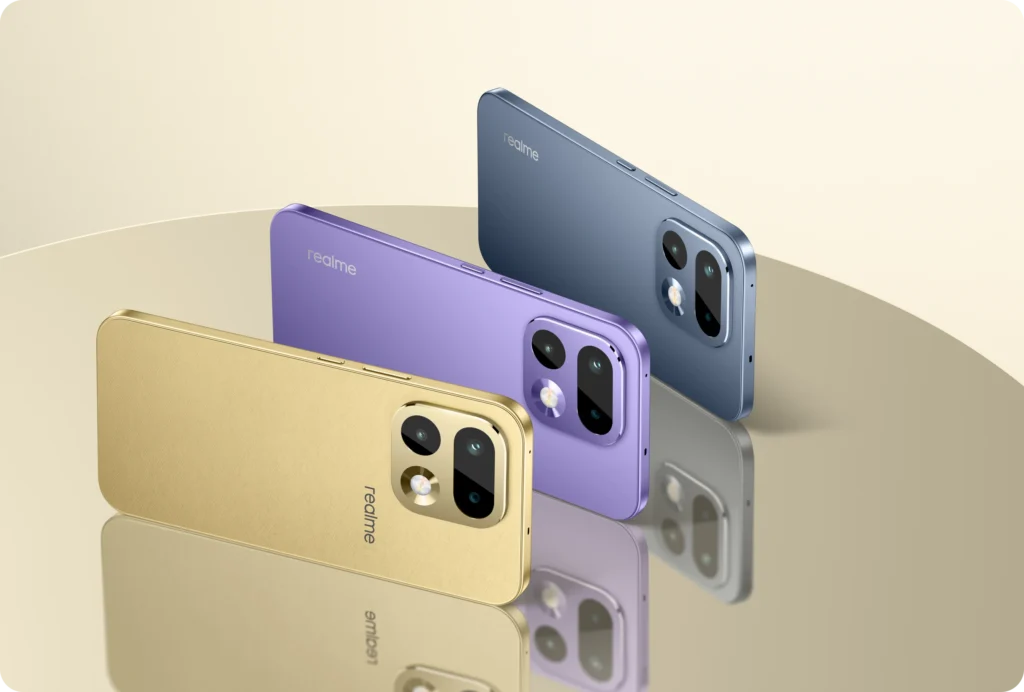
The Realme 16 5G packs a physical selfie mirror, Dimensity 6400 Turbo gaming chip, 7000mAh Titan battery, and industrial-grade IP69K water resistance — all in an 8.10mm body. We go beyond the spec sheet to explain how each of these actually works.
Every few years, a mid-range phone does something that makes you stop and think: wait, why hasn’t anyone done this before? The Realme 16 5G is that phone in 2026. It arrives with a physical selfie mirror built into the rear camera module, a 7000mAh Titan battery hidden inside an 8mm slim body, Dimensity 6400 Turbo gaming performance, and a quad IP rating that includes the industrial-grade IP69K standard.
Each of these features sounds impressive on paper. But what do they actually mean in real life? Let’s break down all four — one by one.
Realme 16 5G Selfie Mirror Explained: How Does It Actually Work?
Here is the problem every smartphone camera designer has lived with for a decade: your best camera is on the back, but your selfie camera is on the front. The rear sensor is larger, captures more light, and produces sharper images — yet for selfies and group shots, you’re forced to use the weaker front camera because you simply cannot see what you’re framing.
Some phones tried a flip camera — bulky and fragile. Some tried a secondary rear display — too expensive for mid-range. The Realme 16 5G selfie mirror is a different approach entirely: a small, polished optical mirror embedded directly into the horizontal camera bar, positioned precisely next to the 50MP Sony IMX852 main sensor.
The Three-Step Process: Twist, Frame, Capture
Realme’s official Flipkart page describes the selfie mirror workflow with the tagline “Twist it. Own it. Trend it.” — and confirms a three-stage process:
- Twist the phone horizontally so the rear panel faces you
- Frame the shot using the mirror, which gives you a real-time optical reflection of exactly what the camera sees
- Capture — a sharper, wider portrait using the 50MP main sensor instead of the front camera
The selfie mirror is a purely optical system — no secondary display, no electronic components, no battery drain. It’s a polished reflective surface. That simplicity is precisely why Realme can offer this feature at a mid-range price point, where adding a rear display would add significant cost.
Realme also bakes quick social sharing directly into this mode, allowing users to post captures to platforms like Instagram immediately after shooting — keeping the entire create-and-share loop within the camera UI.
Why the Sony IMX852 Sensor Matters
The Realme 16 5G selfie mirror is only as useful as the camera it points you toward. The IMX852 is a 50MP, 1/1.57-inch Sony sensor — significantly larger than the typical front camera sensor in this price range. Larger sensors capture more light per pixel, meaning your rear selfie in indoor or low light will look noticeably better than anything the front camera could produce.
Realme pairs this with its LumaColor IMAGE portrait algorithm for real-time skin tone and portrait processing.
Realme 16 5G 7000mAh Battery: How Did They Fit It in 8mm?
The 7000mAh Titan battery is the spec that raises the most eyebrows — and for good reason. Most 2025 mid-rangers ship with 4,500–5,000mAh. Even dedicated power-user phones rarely cross 6,000mAh. At 7000mAh, the Realme 16 5G has more battery capacity than most 2024 flagship phones — yet its body is just 8.10mm thin.
Realme markets this under the “Titan” battery brand, which across their 2025–26 lineup consistently refers to high energy-density cells that achieve greater capacity in tighter dimensions than previous-generation batteries.
What 7000mAh Means for Your Day
Under normal usage, the Realme 16 5G battery should comfortably last two full days without a charge. The 60W wired fast charging brings it back from empty in roughly 75–85 minutes, based on comparable Realme devices. The phone also supports reverse charging — useful for topping up earbuds or a friend’s phone.
The Dimensity 6400 Turbo plays an important supporting role here. Built on TSMC’s 6nm process, it draws less power than older mid-range chips doing the same workload — which amplifies the 7000mAh advantage rather than simply offsetting it.
Note: Some pre-launch coverage has attributed the slim battery design to Silicon-Carbon anode technology. While Silicon-Carbon batteries are a real industry trend offering higher energy density than graphite-anode cells, Realme has not officially confirmed this chemistry for the Realme 16 5G at the time of writing. We’ll update this once confirmed at launch.
Realme 16 5G Dimensity 6400 Turbo Gaming Performance: What to Expect
The Dimensity 6400 Turbo is the chipset powering the Realme 16 5G’s gaming credentials — and understanding what “Turbo” means is important before you set your expectations.
It is an iterative upgrade on the standard Dimensity 6400, built on the same 6nm TSMC architecture with four Cortex-A76 performance cores and four Cortex-A55 efficiency cores. The “Turbo” variant runs at higher sustained clock speeds with improved thermal tuning compared to its predecessor.
Real-World Gaming on Dimensity 6400 Turbo
For the games most Indian users actually play — FC Mobile 2026, BGMI, Free Fire MAX, CarX Street — the Dimensity 6400 Turbo delivers smooth, consistent gameplay at medium to high settings. It handles these titles without the aggressive thermal throttling that made older Dimensity mid-range chips frustrating for extended sessions.
Where it has limits: sustained 90fps in graphically demanding titles like Genshin Impact or Call of Duty Mobile at maximum settings is beyond its comfort zone. If that’s your primary use case, you’d need a Snapdragon 7s Gen 3 or higher. But for the everyday gamer at this price point, the Dimensity 6400 Turbo is a solid and efficient performer.
The 120Hz AMOLED display with 4,200 nits peak brightness rounds out the gaming package. High refresh rate plus AMOLED means deeper blacks, better outdoor visibility, and smoother motion — a genuine upgrade over the LCD displays common in this price segment.
IP69K Explained: Why the Realme 16 5G's Water Resistance Is Different
The Realme 16 5G carries four separate IP water resistance ratings: IP66, IP68, IP69, and IP69K. Most phones launch with one. Here’s what each one actually means — and why IP69K is the one worth understanding.
IP68: The Rating You Already Know
IP68 is the standard used by Apple and Samsung. The “6” means fully dust-tight. The “8” means the phone survives submersion in still water — typically 1.5 metres for 30 minutes. It’s solid protection for drops in pools, sinks, and puddles. What it does not protect against is high-pressure or high-temperature water.
IP69K: The Industrial Standard Most Phones Skip
IP69K is an entirely different test. The device is placed on a rotating table and subjected to high-pressure water jets at temperatures up to 80°C, sprayed from multiple angles at 14–16 litres per minute. Pressure reaches 80–100 bar — far beyond any tap, pool, or rainstorm.
This certification was designed for dairy processing equipment, pharmaceutical machinery, and automotive wash lines. For a smartphone, it means you can rinse it under a high-pressure kitchen tap, clean it after a muddy hike, or hand it to someone with a power washer without worry.
| Rating | What It Protects Against | Real-World Use |
|---|---|---|
| IP66 | Strong water jets from any direction | Heavy rain, outdoor splashing |
| IP68 | Submersion in still water (1.5m, 30 min) | Pool or sink drops |
| IP69 | High-pressure, high-temperature water jets | Pressure washing |
| IP69K | Steam jets up to 80°C at 100 bar | Car wash, industrial rinse-down |
One important clarification: IP69K is not a replacement for IP68 — it tests different conditions entirely. A phone could theoretically pass IP69K and still fail underwater submersion. The Realme 16 5G carries all four ratings together, which is the comprehensive picture.
Verdict: Is the Realme 16 5G Worth Buying?
The Realme 16 5G selfie mirror is not a gimmick — it is a practical, low-cost optical solution to a real photography problem. The 7000mAh Titan battery in an 8.10mm body is genuinely impressive engineering. The IP69K rating is durability that most phones at this price don’t come close to. And the Dimensity 6400 Turbo, paired with a 120Hz AMOLED display, delivers a smooth everyday and gaming experience for the use cases that actually matter to most Indian users.
The Realme 16 5G is not for you if you want a telephoto camera, bleeding-edge gaming performance, or wireless charging. It is absolutely for you if endurance, durability, a quality 50MP main camera, and a genuinely distinctive feature set matter more than raw benchmark numbers.
Full hands-on review coming at launch.
All specifications based on confirmed official Realme/Flipkart teasers and retail box leaks as of March 2026.