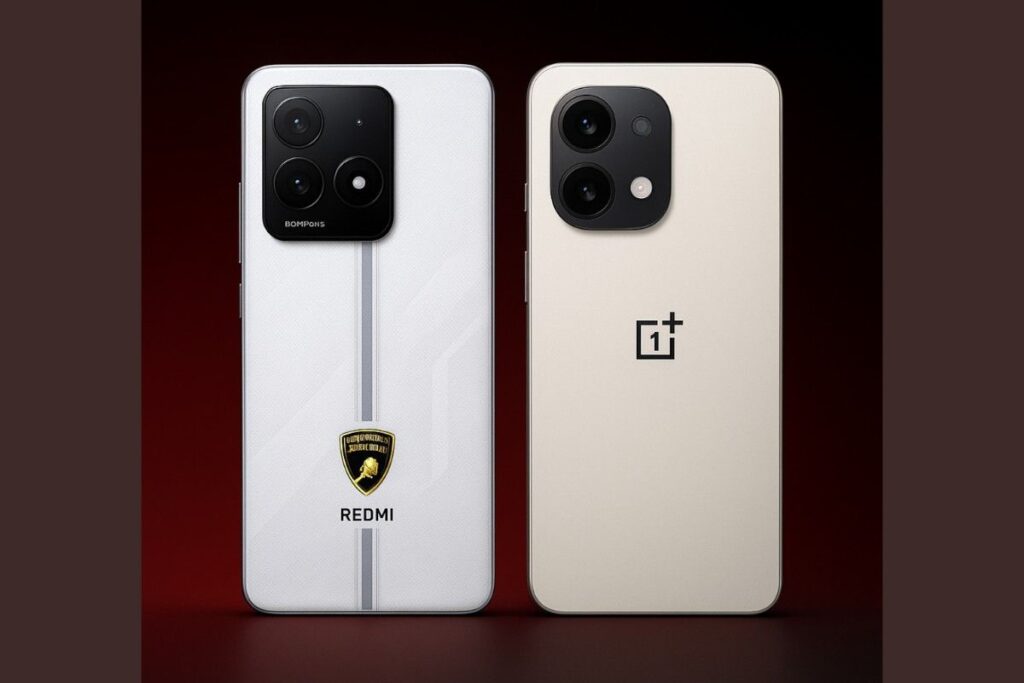
Two power-packed phones, one burning question Snapdragon or Dimensity? The Redmi K90 and OnePlus Ace 6 are redefining midrange performance with flagship-level chips, massive batteries, and stunning displays. But which one truly delivers where it counts: gaming, cameras, battery life, and everyday speed? Let’s dive into a head-to-head showdown that could shape your next upgrade.
Redmi K90 vs OnePlus Ace 6: Midrange Powerhouses
Xiaomi’s new Redmi K90 and OnePlus’s Ace 6 are both high-end midrange phones launched in late 2025. Both pack Qualcomm’s latest Snapdragon 8 Elite chipset (a 3nm flagship chip) and massive batteries, but they target slightly different users.
The Ace 6 is billed as a gamer’s phone it even uses “Wind Chaser” tech and a triple-chip setup to sustain high frame rates while the K90 leans on all-day endurance and balanced specs.
Early benchmarks show the K90 reaching over 2.2 million points on AnTuTu, and the Ace 6 reportedly even higher (around 3.2M in a leaked test). Both have up to 16 GB LPDDR5X RAM and up to 1 TB UFS4 storage, so multitasking and heavy apps run smoothly.
The Ace 6’s Adreno 830 GPU (clocked at 1.1GHz) and 165 Hz display mean games can look ultra-fluid, while its triple-chip design (CPU, network, touch) helps keep gaming smooth.
The K90’s Snapdragon 8 Elite is essentially the same chip family, offering a claimed 45% CPU and 40% GPU boost over the previous generation. In real use, both phones breeze through daily tasks and demanding games.
Users noted that the K90 stays cool under load thanks to Xiaomi’s “3D ice” cooling and Surge chips, and the Ace 6’s bypass charging keeps it cool even while gaming.
Display and Design: Redmi K90 vs OnePlus Ace 6
The OnePlus Ace 6 has a bigger 6.83-inch AMOLED panel at 2800×1272 resolution (1.5K) and a super-smooth 165 Hz adaptive refresh rate. It supports 10-bit color, covers full DCI-P3, and hits around 1800 nits peak brightness (great for outdoor visibility). It even has eye-care modes like low-flicker dimming and adjustable colour temperature
The Redmi K90 uses a slightly smaller 6.59-inch OLED at 2510×1156 (around 2K) and 120 Hz. Xiaomi touts a new OLED substrate (M10 luminous) that boosts brightness up to 3,200–3,500 nits (per lab tests). Crucially, the K90 supports DC dimming at all brightness levels and a TÜV-certified low-blue light mode, which many users find easier on the eyes during long use.
Both phones have slim bezels and punch-hole selfie cams (OnePlus slightly larger cut out for its 16 MP front sensor vs Redmi’s 20 MP). In terms of feel, the Ace 6 is a bit heavier (213 g) than the K90 (206 g), reflecting its larger battery. Both use glass backs and aluminium frames; the K90 even adds an IR blaster. Finally, water resistance is strong on both: the Ace 6 is rated IP66/68/69K and the K90 IP68, meaning each can handle splashes and immersion (the Ace 6 has the most robust protection of the two).
the Ace 6’s screen may appeal to hardcore gamers (extra smooth 165 Hz), while the K90’s sharper 2K panel, extreme brightness, and eye-care tech make it a visual standout for media and long reading sessions.
Redmi K90 vs OnePlus Ace 6 Camera Comparison
The Redmi K90 and OnePlus Ace 6 take very different approaches in photography. The K90 has a true triple-camera system, each 50 MP: a wide main sensor (large 1/1.55″ “Light Hunter” sensor with OIS for low-light shots), a telephoto 2.5× zoom lens with optical stabilization, and an 8 MP ultra-wide with a 120° field of view. The phone uses Leica-inspired processing to deliver punchy colors. It even supports 8K video recording at 30fps or super-slow 4K at 120fps with Dolby Vision HDR. Early samples show detailed, vibrant pictures and rich tones.
The Ace 6, by contrast, has a more modest dual rear camera: a 50 MP Sony IMX906 main sensor (with OIS/EIS) and an 8 MP ultra-wide. There’s no dedicated telephoto, so zoom is digital only. It can shoot 4K video up to 120 fps on the main camera but tops at 1080p for the front.
The K90 offers more versatility its telephoto lets you frame close-ups and portraits sharply at around a 60 mm equivalent, while the Ace 6 relies on cropping. Low-light performance on the K90 should be better thanks to its big sensor and “Night Owl” mode. The Ace 6’s main camera is still high-quality (Sony sensors are known for their clarity), but on paper, the K90’s triple setup has the edge.
Both phones support modern video modes, but only the K90 hits 8K and Dolby Vision. For everyday use, the Ace 6’s camera will suffice for snapshots and social media, but camera enthusiasts will prefer the K90’s extra zoom and imaging flexibility.
Redmi K90 vs OnePlus Ace 6 Battery and Charging Comparison
Both phones pack unusually large batteries for their price. The OnePlus Ace 6 goes huge with a 7800 mAh silicon-carbon cell, paired with 120W SuperVOOC charging. OnePlus claims around 50% charge in just 16 minutes and a full charge in about 43 minutes. It also features a “bypass charging” mode to keep the battery cooler during heavy gaming sessions while plugged in.

The Redmi K90 uses a 7100 mAh battery with 100W wired charging. In tests shared by reviewers, the K90’s all-day battery life is impressive around 18 hours in mixed use (gaming, video, browsing). In real terms, both phones easily last beyond a day even with heavy use.
The Ace 6’s larger battery plus faster charging means quick top-ups, ideal for gamers on the go. The K90’s slightly smaller battery is still enormous, and its 100W charging fills it in under 30 minutes. Neither phone supports wireless charging, though the K90 includes 22.5W reverse charging to power other gadgets.
Software and Updates: Redmi K90 vs OnePlus Ace 6
Out of the box, the K90 runs Xiaomi’s new HyperOS 3 on top of Android 16, while the Ace 6 uses ColorOS 16 (also based on Android 16) from OnePlus and Oppo. Both offer modern UI features and AI tools: HyperOS includes real-time translation and smart photo editing, while ColorOS 16 adds AI Flash Notes and cross-device collaboration that can even connect with iPhones and Macs.
OnePlus has confirmed that the Ace 6 will get a global release (as the OnePlus 15R) soon, meaning a global Android build will follow. Current Chinese units may include some local apps, similar to the Redmi version.
Both companies promise long-term support. Xiaomi guarantees four years of Android updates and five years of security patches, while OnePlus (under Oppo) has similar commitments for its 2025 lineup.
Redmi K90 or OnePlus Ace 6: Best Value for Money?
ChatGPT said:
Pricing is very aggressive for both phones. In China, they actually overlap: the base 12GB + 256GB models for each launched around 2599 yuan (about $360). Top configurations (16GB + 1TB) reach about 3899–3999 yuan (around $550) for both. This undercuts many pricier flagships while offering similar performance and features. Importers, or the global OnePlus 15R version of the Ace 6, sell them slightly higher, but still well below premium devices.
In short, each phone delivers tremendous value for the money. The K90 is clearly positioned as a “flagship killer,” offering around 90% of the flagship experience for roughly half the cost. The Ace 6 similarly undercuts other gaming phones by bundling top-tier hardware with a midrange price.
Buyers will appreciate that both models have high-end build quality aluminium frames, glass backs, and stereo speakers despite their midrange labels. The deciding factors come down to priorities: if you want raw gaming power, a bigger battery, and the highest refresh rate display, the Ace 6 stands out. If you prefer versatile cameras, an ultra-bright display with eye comfort features, and a slightly lighter design, the K90 is the better pick. Either way, both deliver flagship-level performance and premium features at a very competitive price.