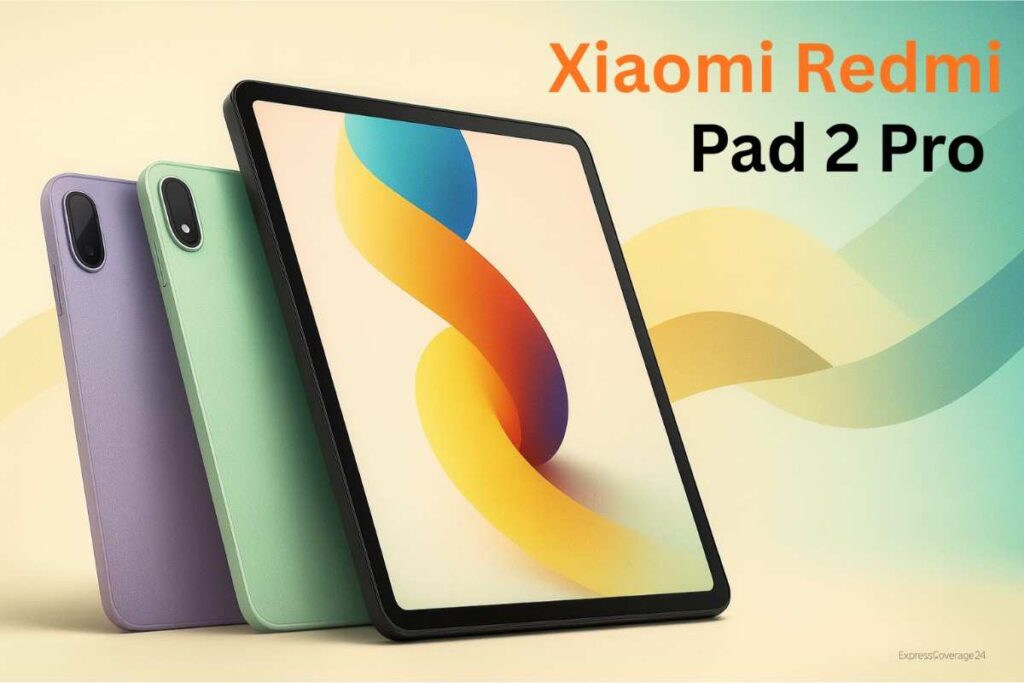
Xiaomi’s Redmi sub-brand has just unveiled the Redmi Pad 2 Pro, a large-screen Android tablet aimed at budget-conscious consumers who want flagship-style features. Announced in late September 2025, the Pad 2 Pro packs a huge 12.1-inch display, a massive 12,000 mAh battery, and the new Snapdragon 7s Gen 4 processor. In simple terms, it’s an upgraded follow-up to last year’s Redmi Pad Pro, offering a bigger screen and longer runtimes for a very reasonable price.
Xiaomi Redmi Pad 2 Pro Design and Display
The standout feature of the Redmi Pad 2 Pro is its 12.1-inch LCD screen. This large display offers a 2.5K resolution (2560×1600 pixels, 16:10 aspect) and supports an adaptive 120 Hz refresh rate, making scrolling and video playback very smooth.
Xiaomi even advertises advanced features like Dolby Vision HDR, TÜV Rheinland eye-care certifications (low blue light and flicker-free), and a special “wet touch” mode so the screen stays responsive if your fingers are damp. For users who often read outdoors or in bright rooms, there’s an optional Matte Glass version of the tablet with an anti-glare coating that cuts reflection by up to 97%.
Audio is also a focus: like many Xiaomi tablets, the Pad 2 Pro has a quad-speaker stereo setup with Dolby Atmos support.
Xiaomi even claims a “300% volume boost” feature for extra loudness without distortion. In everyday use, that means movie soundtracks and music will come through more clearly than on a cheap single-speaker tablet.
The build is a slim unibody metal frame (about 7.5 mm thick) in three colors – Graphite Gray, Silver, and Lavender Purple – and it weighs around 610 g. Despite the big display, it’s still light enough to hold on the sofa or put in a bag.
Xiaomi Redmi Pad 2 Pro Performance and Hardware
Under the hood, the Redmi Pad 2 Pro runs on the Qualcomm Snapdragon 7s Gen 4 platform (a new mid-range chipset built on a 4 nm process). This offers a good balance of power and efficiency.
The tablet comes in two memory/storage configurations: 6 GB RAM with 128 GB storage or 8 GB RAM with 256 GB storage.
If that isn’t enough, there’s also a full-size microSD slot for expanding storage up to 2 TB.
With this hardware, the Pad 2 Pro is well-suited for everyday tasks. Web browsing, video streaming, and even light Android gaming will feel snappy.
The Snapdragon 7s Gen 4 outperforms the older Snapdragon 7s Gen 2 in last year’s Redmi Pad Pro, especially in graphics and CPU-intensive tasks.
That said, it’s still a mid-range chip, so ultra-high-end games on max settings might not run as smoothly as on a flagship. But for most users, performance should be more than adequate given the tablet’s price.
Powering all this is a huge 12,000 mAh battery, one of the largest you’ll find in any Android tablet. Xiaomi claims up to about 14.2 hours of video playback or 16 hours of reading on one charge.
In practice, you can expect a full day or two of normal use (streaming video, browsing, etc.) before needing to recharge.
Charging isn’t lightning-fast – the Pad 2 Pro supports 33 W wired fast charge – but that’s enough to top the tablet from near empty to full in roughly an hour and a half. There’s also 27 W reverse wired charging, so you could use the tablet to charge a smartphone or earbuds in a pinch.
Also read: Redmi Note 15 Pro Review: Is Xiaomi’s Latest Phone That Good?
Xiaomi Redmi Pad 2 Pro Cameras and Connectivity
The cameras on the Pad 2 Pro are modest, as with most affordable tablets. The Wi-Fi model has an 8 MP rear camera and an 8 MP front-facing camera. These are mainly intended for video calls and document scanning – don’t expect DSLR-quality photos.
Interestingly, the optional 5G version of the Pad 2 Pro upgrades the rear camera to 13 MP (while the front stays 8 MP). Otherwise, the camera system is very basic: there’s no wide-angle lens or autofocus, but there is an LED flash on the back to help in low light.
For connectivity, the tablet covers all the essentials. It has Wi-Fi 6 support and Bluetooth 5.4. A 5G model is available (using an embedded SIM), so if you need cellular data on-the-go, you can pay extra for that variant.
There’s also a USB-C port for charging/data, a 3.5 mm headphone jack, and the aforementioned microSD slot for storage. A nice touch is built-in support for a stylus and keyboard.
Xiaomi sells an optional Redmi Smart Pen and a full-sized keyboard cover, turning the Pad 2 Pro into a mini-laptop for note-taking or productivity.
Xiaomi Redmi Pad 2 Pro Software and Special Features
Out of the box, the Redmi Pad 2 Pro runs Android 15 with Xiaomi’s new HyperOS 2 skin. HyperOS is designed for cross-device integration.
For example, you can mirror and control your Xiaomi phone’s screen on the tablet, share clipboard text between devices, sync calls and messages, and even use the Pad’s camera in a video call on your phone.
Xiaomi also built in Google Gemini AI tools for on-device assistance (like summarizing, searching, and writing help). In short, the software is modern and features-rich for 2025 – something to highlight if you care about having the latest Android features.
Xiaomi Redmi Pad 2 Pro Pricing and Availability
Xiaomi has launched the Redmi Pad 2 Pro globally, but India pricing is not yet announced. In Europe, prices start at €299.99 (about ₹31,000) for the Wi-Fi 6GB/128GB model.
The higher-end 8 GB/256 GB Wi-Fi model is €349.99, and the special Matte Glass edition with 8/256 costs €379.99. The 5G version (at least the 6/128 configuration) is also priced at around €379.99. Accessories like the Keyboard (€99.99) and Smart Pen (€69.99) are sold separately.
To put that in context, €299.99 is roughly equivalent to ₹31,000 – just a bit higher than the Redmi Pad 2 (4G) base model which launched at ₹12,999. That means the Pad 2 Pro is a premium upgrade (and indeed costs a lot more). If/when it arrives in India, expect a starting price around ₹32K–₹35K.
Also read: OnePlus 15 teased as the first phone to launch with Qualcomm’s Snapdragon 8 Elite Gen 5
Xiaomi Redmi Pad 2 Pro Key Features at a Glance
- Huge 12.1″ 2.5K display (2560×1600, 120 Hz, Dolby Vision, TÜV eye-care). Optional matte glass anti-glare version.
- Snapdragon 7s Gen 4 chipset (4 nm), up to 8 GB RAM, up to 256 GB storage plus microSD expansion.
- 12,000 mAh battery with 33 W fast charging and 27 W reverse charging. Exceptional endurance.
- Quad speakers with Dolby Atmos (and Hi-Res Audio).
- Android 15 with HyperOS 2 and Google Gemini AI features.
- Stylus and keyboard support (sold separately).
- Optional 5G variant and 3.5 mm headphone jack.
- Metal unibody design, thin (7.5 mm) and available in three colors.
Xiaomi Redmi Pad 2 Pro Comparisons with Other Tablets
Realme Pad X (2022):
11″ display, Snapdragon 695 5G, and an 8,340 mAh battery. It’s cheaper but offers weaker performance, smaller screen, and shorter battery life compared to the Redmi Pad 2 Pro.
Xiaomi Pad 6 (2023):
11″ sharper 2880×1800 144 Hz display and Snapdragon 870 chip. While its screen resolution is higher, its battery is smaller at 8,840 mAh. The Pad 2 Pro wins on longevity and has newer software.
Samsung Galaxy Tab A9+ (2023):
11″ 1920×1200 screen at 90 Hz, Snapdragon 695, and a much smaller 5,100 mAh battery. It’s budget-friendly but can’t compete with the Pad 2 Pro in performance, display quality, or endurance.
Pros and Cons
Pros:
- Stunning large screen (12.1″ 2.5K, 120 Hz)
- Monster battery (12,000 mAh) with reverse charging
- Dolby Atmos quad speakers
- Modern software (Android 15/HyperOS 2)
- Expandable storage and stylus/keyboard support
- Optional 5G model
- Premium metal build
Cons:
Heavier and bulkier than smaller tablets
Charging speed (33 W) could be faster
Basic camera setup
No fingerprint sensor
Mid-range processor (not for heavy gaming)
India launch details still pending
Who Is This For?
The Redmi Pad 2 Pro is aimed at media lovers, families, and light productivity users.
Its large screen and great battery make the Xiaomi 17 Pro Max ideal for movies, video streaming, e-book reading, and casual gaming. Students and professionals can also benefit from the optional pen and keyboard, plus HyperOS features like split-screen and AI tools. It’s not meant for high-end gamers or content creators, but for everyday use it offers excellent value.
Also read: Snapdragon 8 Elite vs Tensor G5: The Ultimate Showdown of Next-Gen Smartphone Processors
Conclusion
The Xiaomi Redmi Pad 2 Pro is an ambitious tablet that brings premium features to the mid-range.
Its strengths lie in its huge display, long battery life, and quad-speaker sound, all wrapped in modern software. While it has some compromises, it stands out for its value.
If Xiaomi brings it to India, the Pad 2 Pro will likely shake up the affordable tablet market – offering an all-around solid experience for consumers who want more screen and runtime without breaking the bank.