iQOO 15R Official: 7,600mAh Battery, Snapdragon 8 Gen 5, and Next-Gen Performance
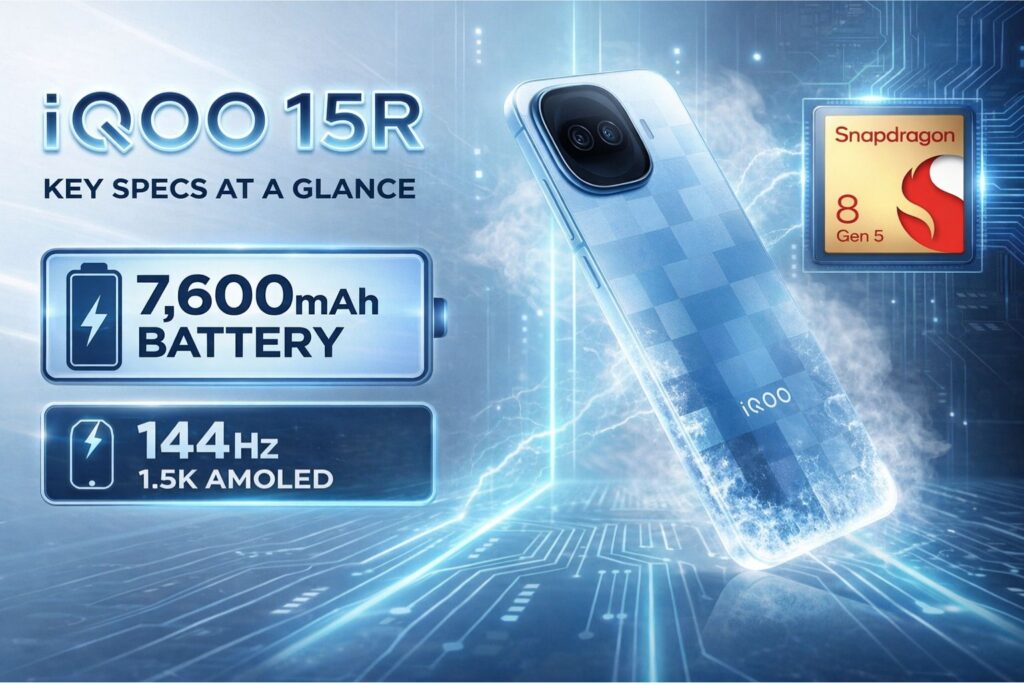
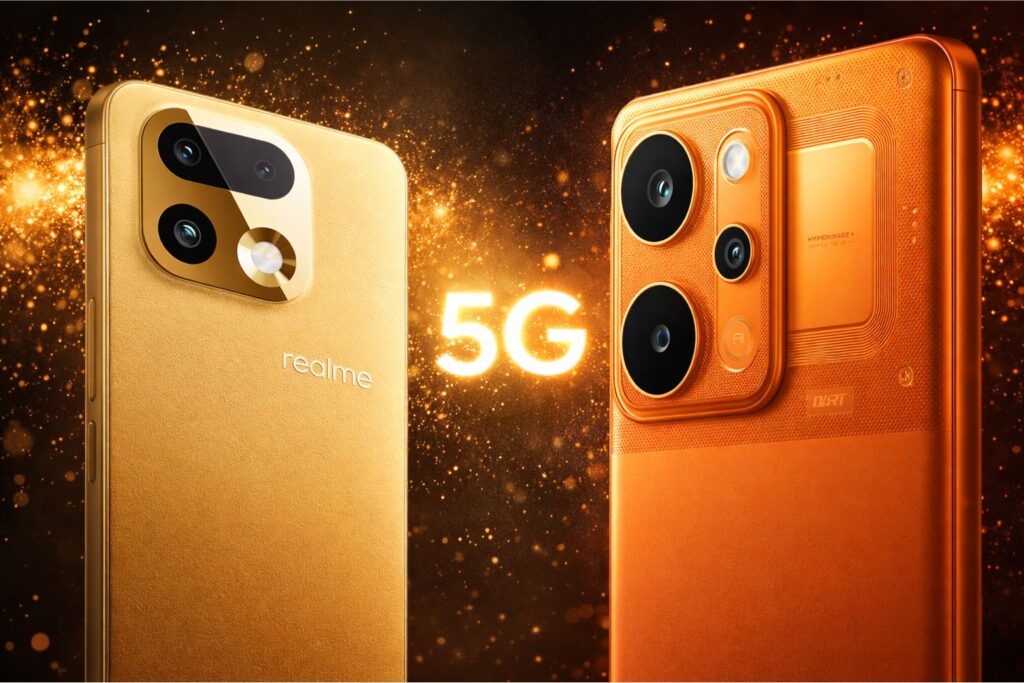
The iQOO 15R is positioned as a “flagship killer” for 2026, targeting power users and mobile gamers who prioritize performance and endurance. It incorporates several industry-first specifications, most notably a high-density battery and a top-tier mobile platform. The device serves as a mid-generation update in the iQOO 15 series, bridging the gap between high-end mid-range and premium flagship segments. It officially launches in India on February 24, 2026. Design and Build The iQOO 15R features a glass-on-glass construction with a metal frame for structural rigidity. Despite its high battery capacity, the device maintains a slim profile of 7.9mm and weighs approximately 206 grams. It is rated IP68 and IP69 for dust and water resistance, providing protection against immersion and high-pressure water jets. The front is dominated by a flat 6.59-inch 1.5K AMOLED display. Display Resolution: 2750 x 1260 pixels (459 ppi). Refresh Rate: 144Hz (LTPS-based adaptive). Peak Brightness: 1,800 nits global brightness. Security: New-gen 3D Ultrasonic under-display fingerprint sensor. Performance Under the hood, the iQOO 15R is powered by the Qualcomm Snapdragon 8 Gen 5 chipset, manufactured on a 3nm process. This silicon features the new Oryon CPU architecture, delivering a 36% improvement in single-core performance over its predecessor. The device has officially recorded an AnTuTu score exceeding 3.5 million points. This benchmark measures overall system performance, including CPU, GPU (Adreno 829), and memory speeds, placing it at the top of current mobile rankings. RAM: 12GB / 16GB LPDDR5X Ultra. Storage: 256GB / 512GB UFS 4.1. Gaming Hardware: Includes a dedicated Q2 Supercomputing chip to handle frame interpolation and game stabilization. Battery and Charging A primary feature of the iQOO 15R is its 7,600mAh Silicon Carbon battery. This technology allows for higher energy density, enabling the large capacity to fit within a sub-8mm chassis. The phone supports 120W Flash Charging, capable of replenishing the battery from 1% to 50% in approximately 16 minutes. Battery Type: Non-removable Silicon Carbon. Wired Charging: 120W (USB Type-C 2.0). Efficiency: The Snapdragon 8 Gen 5’s improved efficiency provides an estimated 22 hours of continuous video playback. The Number series, currently led by the Realme 16 lineup, focuses on delivering a balanced mid-range experience with an emphasis on display quality and camera hardware. This series is positioned for users seeking advanced features typically found in higher-priced devices. Camera System iQOO has confirmed the transition from high megapixel counts to a larger, more efficient sensor for the Indian market. The 15R utilizes the 50MP Sony LYT-700 as its primary sensor. The camera system focuses on low-light dynamic range rather than digital zoom. It is capable of 4K video recording at 60fps with full Optical Image Stabilization (OIS). Rear Primary: 50MP Sony LYT-700 (f/1.8, OIS). Rear Ultra-wide: 8MP (f/2.2, 116° FOV). Front Camera: 32MP (f/2.2, 4K support). Software and Features The device debuts with OriginOS 6 based on Android 16. A notable software inclusion is Origin Island, a dynamic notification zone that integrates live activity alerts and quick controls. iQOO has officially committed to a long-term update policy. The device will receive 4 years of major Android OS upgrades and 6 years of security patches, ensuring support until 2032. Connectivity: 5G (multi-band support), Wi-Fi 7, and Bluetooth 5.4. AI Tools: Includes system-level AI for document scanning, live captions, and real-time transcription. Comparison with Rivals Feature iQOO 15R OnePlus 15R Samsung Galaxy S26 FE (Exp.) Processor Snapdragon 8 Gen 5 Snapdragon 8 Gen 5 Exynos 2600 / SD 8 Gen 5 Battery 7,600mAh 7,400mAh 5,000mAh AnTuTu Score 3.5M+ 3.4M 3.1M Display 6.59″ 1.5K 144Hz 6.83″ 1.5K 165Hz 6.4″ FHD+ 120Hz Charging 120W Wired 100W Wired 45W Wired Price (Est.) ₹47,999 – ₹52,000 ₹49,999 ₹59,999 Pricing and Availability The iQOO 15R is confirmed to be priced under ₹55,000 in India, with the base 12GB+256GB variant expected to start at ₹47,999. It will be available for purchase via Amazon India and the iQOO e-store starting late February. The device will be offered in two primary colorways: Dark Knight: A matte black finish. Blue Variant: A blue panel featuring a textured chequered pattern. Also read: The Best Lenovo Tablet for Students: Taking Notes, Battery Life, and More Conclusion The iQOO 15R prioritizes raw performance and battery longevity over high-end telephoto photography. Its combination of the Snapdragon 8 Gen 5 and a 7,600mAh battery makes it a niche but powerful option for gamers and heavy enterprise users. Strengths: Industry-leading battery density, record-breaking performance benchmarks, and a long-term software commitment. Trade-offs: Lacks a dedicated telephoto lens; charging speeds are slightly lower than previous Neo-series flagships to preserve the slim battery design. Sources: iQOO India Official Microsite (2026). Qualcomm Snapdragon 8 Gen 5 Technical Specifications (2025). AnTuTu Benchmark Public Database (February 2026). 91mobiles & Gadgets360 Tech Briefings (February 2026).
iQOO 15R Official: 7,600mAh Battery, Snapdragon 8 Gen 5, and Next-Gen Performance Read More »