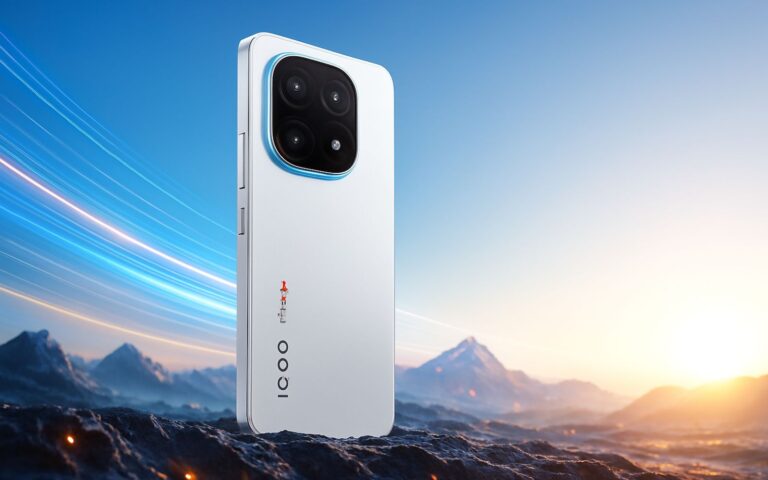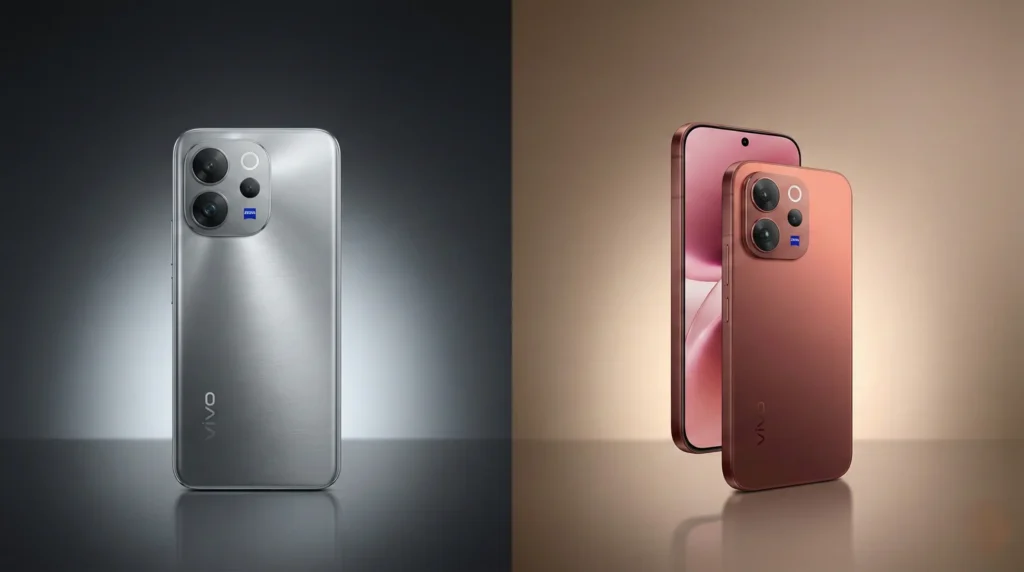
The Vivo V70 series landed in India on February 19, 2026, presenting buyers with a choice that goes beyond simply picking a colour. At ₹45,999, the standard V70 is already a well-equipped mid-range contender.
But for ₹51,999, a ₹6,000 premium, the V70 Elite swaps in a significantly more powerful processor. Whether that swap justifies the extra spend depends entirely on how you use your phone.
Pricing at Launch (8GB + 256GB Base Variants)
| Model | Launch Price |
|---|---|
| Vivo V70 | ₹45,999 |
| Vivo V70 Elite | ₹51,999 |
What Both Phones Share
Understanding what you are not giving up by choosing the standard model is just as important as knowing what the Elite adds. Across the entire V70 lineup, Vivo has kept the core experience consistent.
Display: Both models feature a 6.59-inch 1.5K flat AMOLED panel with a 120Hz adaptive refresh rate and a peak brightness of 5,000 nits — one of the brightest screens available in this price segment, making outdoor visibility a non-issue.
Battery and Charging: A 6,500mAh battery powers both devices, supported by 90W wired fast charging. This combination puts them among the longest-lasting phones in their class.
Camera System: This is arguably the most important shared trait. Both the V70 and V70 Elite carry an identical triple rear camera setup developed in collaboration with ZEISS — a 50MP main sensor (Sony IMX766), a 50MP periscope telephoto lens (Sony IMX882) with 3x optical zoom, and an 8MP ultra-wide. The front camera is a 50MP unit on both. Since the hardware is identical, image quality will not differ between the two models.
Durability: Both phones are rated IP68 and IP69, meaning they are protected against prolonged submersion in water as well as high-pressure water jets — a combination that is uncommon at this price point.
Software and Longevity: Both run Android 16-based OriginOS 6 out of the box and are backed by Vivo’s commitment of four major OS updates and six years of security patches.
Where the ₹6,000 Goes: The Chipset Difference
The single most significant difference between these two phones is the processor, and it has real-world consequences.
Vivo V70 — Snapdragon 7 Gen 4
The Snapdragon 7 Gen 4 is Qualcomm’s refined upper mid-range platform. Clocked at 2.8GHz, it is engineered for efficiency and handles everyday workloads such as browsing, streaming, multitasking, photography, and casual gaming with ease. It is not a chipset that will feel slow in 2026, but it does not carry the raw headroom of a flagship tier processor.
Vivo V70 Elite — Snapdragon 8s Gen 3
The Snapdragon 8s Gen 3 is a different class of chip. Clocked at 3.0GHz with Qualcomm’s Adreno 735 GPU, it is a platform designed to handle demanding tasks that the 7 Gen 4 simply cannot match at the same level. Here is what that means practically:
- Benchmark Performance: The 8s Gen 3 scores approximately 1.8 million on AnTuTu, with GPU performance roughly 92% more powerful than its predecessor.
- Gaming: The Elite supports 120fps gameplay in titles like Call of Duty Mobile and 90fps in BGMI — frame rates the standard V70 cannot sustain.
- Video Editing: Tasks like 4K 60fps video editing, which demand simultaneous processing from both the CPU and GPU, run noticeably smoother on the Elite’s more powerful chip.
- Storage: Both phones use UFS 4.1 storage, but the Elite’s more advanced chipset controller extracts better sustained read/write performance from that storage.
The Smaller Differences Worth Knowing
Beyond the processor, there are a couple of physical distinctions. The Elite is built with a fiberglass back panel and measures 7.4mm in thickness, compared to the standard V70’s 7.59mm, making it marginally slimmer and slightly more premium in feel.
On connectivity, the Elite offers Wi-Fi 6 support across all variants, while the standard V70’s Wi-Fi capabilities vary by configuration.
Who Should Buy Which Model?
Choose the Vivo V70 if your primary use cases are photography, social media, content consumption, and everyday communication. Since the camera hardware is identical on both models, you are receiving the same ZEISS optics and imaging capability for ₹6,000 less. For the majority of users, the Snapdragon 7 Gen 4 delivers perfectly capable, fluid performance for daily tasks.
Choose the Vivo V70 Elite if you are a mobile gamer, a content creator who edits video directly on your phone, or someone who prioritises having the most future-proof version of a device. The Snapdragon 8s Gen 3 offers substantially greater processing headroom, meaning it will handle increasingly demanding apps and games more comfortably over the next three to four years than the standard model will.
The Bottom Line
The Vivo V70 is the rational choice for most buyers, particularly those who value camera performance, battery life, and durability above all else, since those three areas are entirely equal across the lineup.
The V70 Elite, however, is not simply a marginal upgrade. It represents a genuine performance tier jump. If your usage patterns include competitive gaming or intensive creative work, that ₹6,000 is a well directed investment. If they do not, it is money that could stay in your pocket without any compromise to your day to day experience.