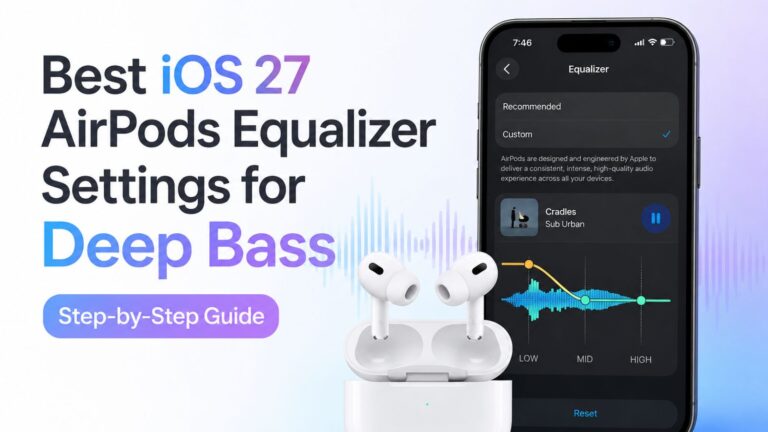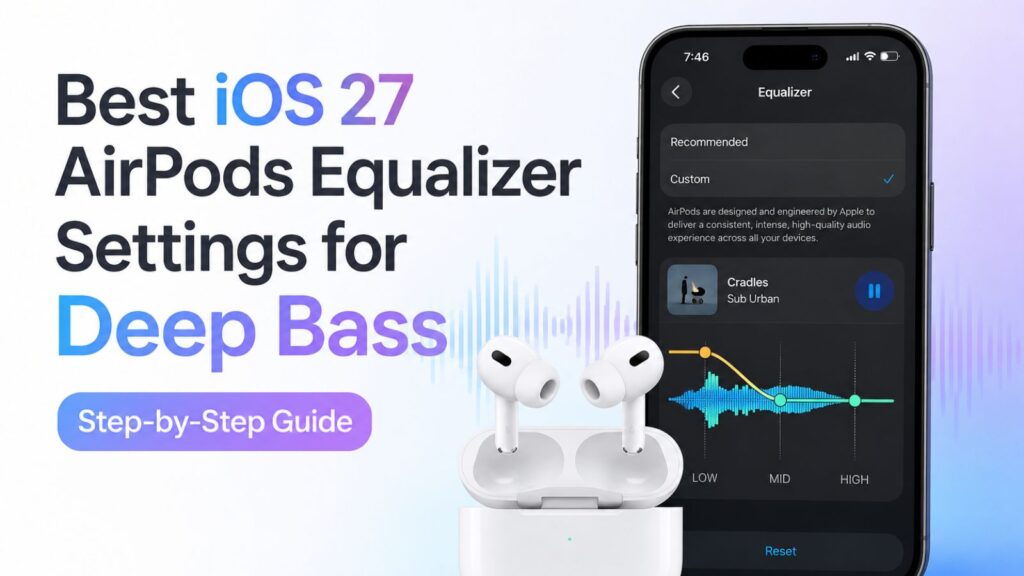
If you love bass-heavy music like EDM, hip-hop, or R&B, standard headphone presets usually leave a lot to be desired. For years, iPhone users have had to rely on basic built-in presets (like “Bass Booster”) that often muddled the mids and highs.
That changes completely with the release of the native manual equalizer in iOS 27.
Finally, Apple has given audiophiles the granular control they’ve been asking for. But because the iOS 27 settings menu received a massive overhaul, finding the new manual EQ and dialing in the perfect low-end can be tricky. In this guide, we’ll show you exactly where is custom eq in ios 27 airpods settings and give you the best parameters for hard-hitting, deep bass.
Where is Custom EQ in iOS 27 AirPods Settings?
Apple relocated several audio features out of the general “Music” app settings and directly into the AirPods device menu to streamline the experience. Here is exactly how to find the new 5-band manual equalizer:
Take your AirPods out of their case and ensure they are actively connected to your iPhone.
Launch the main Settings app on your iPhone.
Because of the new iOS 27 interface, your AirPods now have a dedicated sub-menu right at the top of the screen.
Scroll down past Noise Control and tap on Audio Output & EQ.
Switch the toggle from “Presets” to Manual. This will reveal the new 5-band interactive slider.
Understanding Your EQ: Visualize the Bass
Before you start dragging sliders blindly, it helps to understand what you are actually adjusting. The human ear hears frequencies from 20Hz (deep rumble) to 20,000Hz (high-pitched piercing).
To get “deep bass” without ruining the rest of the track, you need to boost the lower frequencies while slightly managing the mids. Use this interactive equalizer to see how adjusting the bass bands (60Hz and 250Hz) changes the overall sound profile:
5-Band Audio Equalizer
Pro Tip: Never push all sliders to the top. Audio engineering is about balance. If you boost the bass too high without lowering the mids, you will cause distortion (clipping) at high volumes.
The Best iOS 27 AirPods Equalizer Settings for Deep Bass
To get that rich, vibrating bass without sounding like you’re listening underwater, you want to create a gentle curve (often called a “U-curve” or “V-curve” in audio engineering).
Here are the exact decibel (dB) settings to apply in your new iOS 27 manual EQ:
| Frequency Band | Adjustment | What It Does |
| 60 Hz (Sub-Bass) | +4 dB to +6 dB | Delivers the physical “thump” you feel in hip-hop and EDM kicks. |
| 250 Hz (Mid-Bass) | +2 dB | Warms up the bass line and heavy synth notes. |
| 1 kHz (Midrange) | -1 dB | Slightly scoops the vocals to make room for the bass to breathe. |
| 4 kHz (Presence) | +1 dB | Adds clarity back to snare drums and lead vocals. |
| 8 kHz (Treble) | +2 dB | Keeps the hi-hats and cymbals crisp so the mix doesn’t sound muddy. |
Does this work on third-party headphones?
One of the best surprises of iOS 27 is that while the settings are housed in the AirPods menu, the custom EQ does carry over to Beats and select third-party Bluetooth headphones, though the interface will be located under Settings > Bluetooth > [Device Name] instead.